The Catholic comic Treasure Chest is actually a mini-gold mine for someone looking for Golden or Silver Age comic books featuring African Americans. In Treasure Chest there are a mixture of fictional and factual stories, and it is true accounts of the lives and activities of famous African Americans that are sometimes depicted. I picked this story about the baseball player Satchel Paige especially because of the last three panels, but generally because Paige is someone I had never heard of before, and it was interesting reading about him. Those last three panels really drive home the role that African American sports personalities played in bridging the racial divide. That they had to shoulder this responsibility speaks to the power of prejudice against difference that develops in unenlightened societies, as people allow themselves to be driven by their animal instincts instead of their intelligence. Unfortunately, the achievements of so many other African Americans remain unknown because of a color-filtered mechanism of apportioning worth to human activity. Anyway, this is a charming tale about someone who was, by this account, a good man and someone well worth knowing about. We know about him because of his success in baseball, something the majority in society recognized as an accomplishment and that earned him respect. "The Ageless Satchel Paige" is from Treasure Chest Vol. 8 # 17, April 23, 1953.
Published by George A. Pflaum of Dayton, Ohio, the original Treasure Chest series ran from 1946-1972 and was only available on subscription or through Catholic schools, where they were a classroom resource. Until the 1960s the comics were published bi-weekly, and thereafter were monthly and twice the size. More information on Treasure Chest is available in a Wikipedia entry:
http://en.wikipedia.org/wiki/Treasure_Chest_%28comics%29
Wednesday, April 6, 2011
Monday, April 4, 2011
Crossing the Divide: The Harlem Globetrotters (1)
In the early 1950s, Ziff-Davis published Bill Stern's Sports Book, a comic book in the sports genre. Volume 2 # 2 (Winter, 1952) was a 100 page square bound 25c comic, and contained several stories featuring African American sports stars. The first in the book (and the hardest to scan!) was about the origins of the Harlem Globetrotters. Drawn by Everett Raymond Kinstler, it's an artistic gem, but it's also an interesting read as it follows the early exploits of the world's most famous basketball team. What's important to remember is that this comic was published during the period when segregation was still in force in the USA. The Globetrotters are another example of African American sports personalities who were able to induce members of the majority population previously entrenched in a dualistic stance on race, at least to some extent traverse the race barrier. Like all African American sports personalities of the time, in addition to having to make a name for themselves in their field, the Globetrotters had thrust upon them the responsibility of representing the African American community or 'race' as a whole, an unwholesome burden inflicted by a society divided along racial lines.
For sportsmen like the Harlem Globetrotters, that hard-earned recognition made its own contribution to breaking down the race barrier, even though such representation should never have been necessary in the first place. But that was how American society had evolved at the time, on its road towards making the words of the Declaration of Independence and the Constitution of the United States become a reality. Looks like the Globetrotters also had the privilege of being some of the first people to have their portraits drawn by Kinstler, for whom several U.S. Presidents have subsequently sat! Kinstler nowadays is recognized as one of the greatest portrait artists of all time.
Sunday, April 3, 2011
Crossing the Divide: Joe Louis (1)
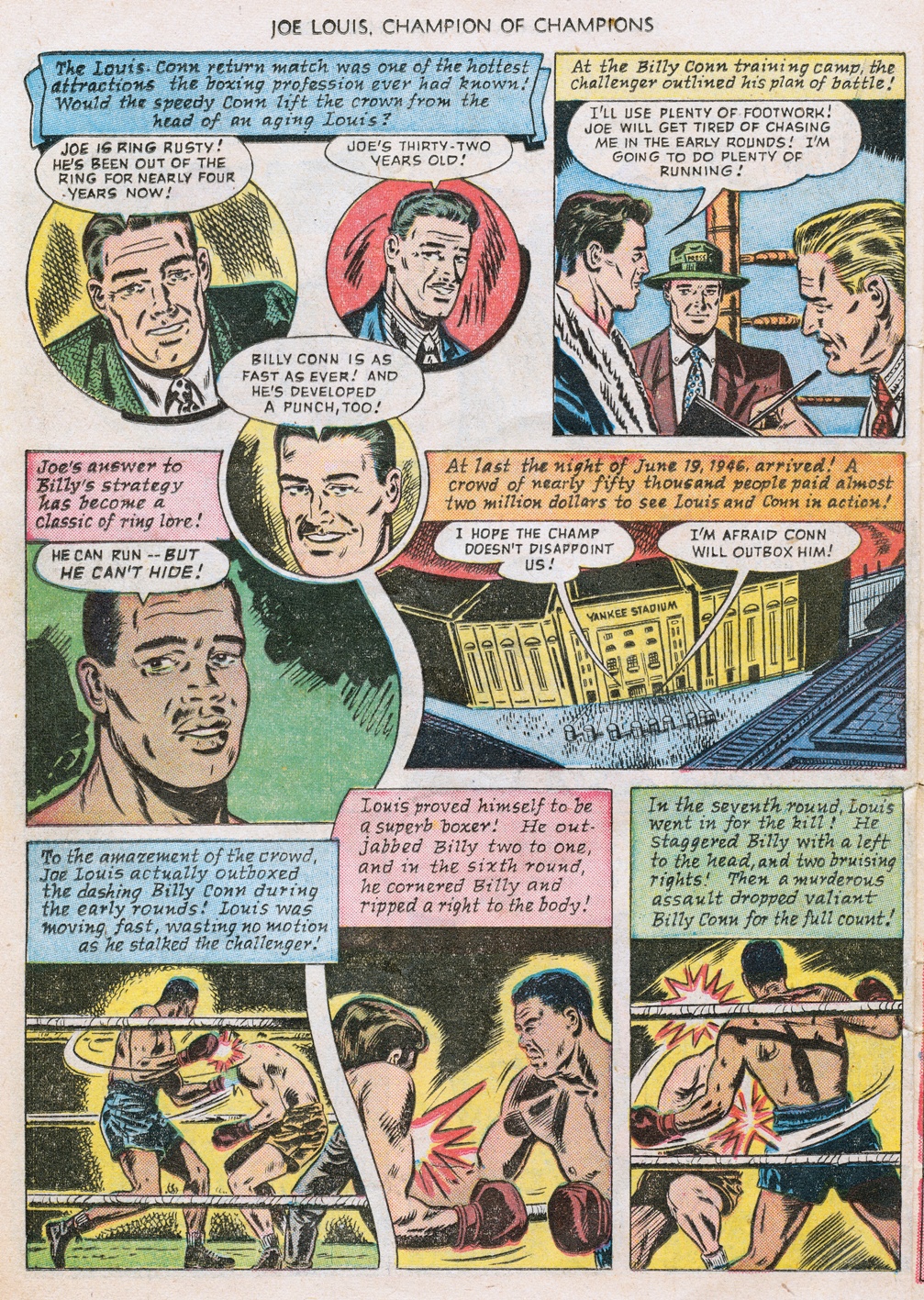
One of the stages in racial integration and desegregation in the United States was the period in which famous African American sports personalities became widely accepted for their achievements thus 'proving' racial equality. Although in one sense it is deplorable that such 'proof' should be required, it is nevertheless undeniable that this phenomenon occurred, and it is reflected in comic books of the period. In boxing this goes back to the early 20th Century heavyweight champion Jack Johnson (champ from 1908-1915). Society was so racially charged at that time that the famous author Jack London called for a 'great white hope' to come forth and defeat Johnson. It wasn't until Joe Louis became champ from 1937-1949 that an African American boxer was admired by all regardless of race. Louis's undermining of Hitler's 'Master Race' theory by defeating Max Schmeling was certainly influential in this regard.Sports comics as a genre tend to simply report the achievements of great sports stars, and the comic book series featuring them inevitably run out of material, the one example I can think of that doesn't follow this format being the Harlem Globetrotters Gold Key series of the early 1970s based on the Hanna Barbera TV cartoon. Because they are seen as sports memorabilia, sports comics are collected by sports fans, irritatingly driving the price up for comic book collectors. Here's one that I managed to get for a 'reasonable' price, Fawcett's Joe Louis Champion of Champions 2. In the early 1950s Fawcett seemed very serious about breaking into the African American comics market. They published Negro Romances (3 issues) and a variety of sports comics featuring African American sports personalities (e.g. Joe Louis, Jackie Robinson). Unfortunately none lasted long, and it must mean that poor sales caused them to cancel publication. Whether racist distributors were the reason for the poor sales (as happened with Dell's Lobo in the 1960s) I don't know, but at least Fawcett made a significant effort to change the comic book landscape and introduce diversity in a bigger way at the time than any other comic book company. So here's the Joe Louis story from Joe Louis 2. I've uploaded the entire comic to the Digital Comic Museum and you can download it from http://digitalcomicmuseum.com/index.php?dlid=14202
Out Of This World will be featuring some more examples of African Americans in sports comics in the future, so watch this space!
Saturday, April 2, 2011
Nurses as Objects in Comics: Dogface Dooley 3 - "The Tattooed Sergeant"
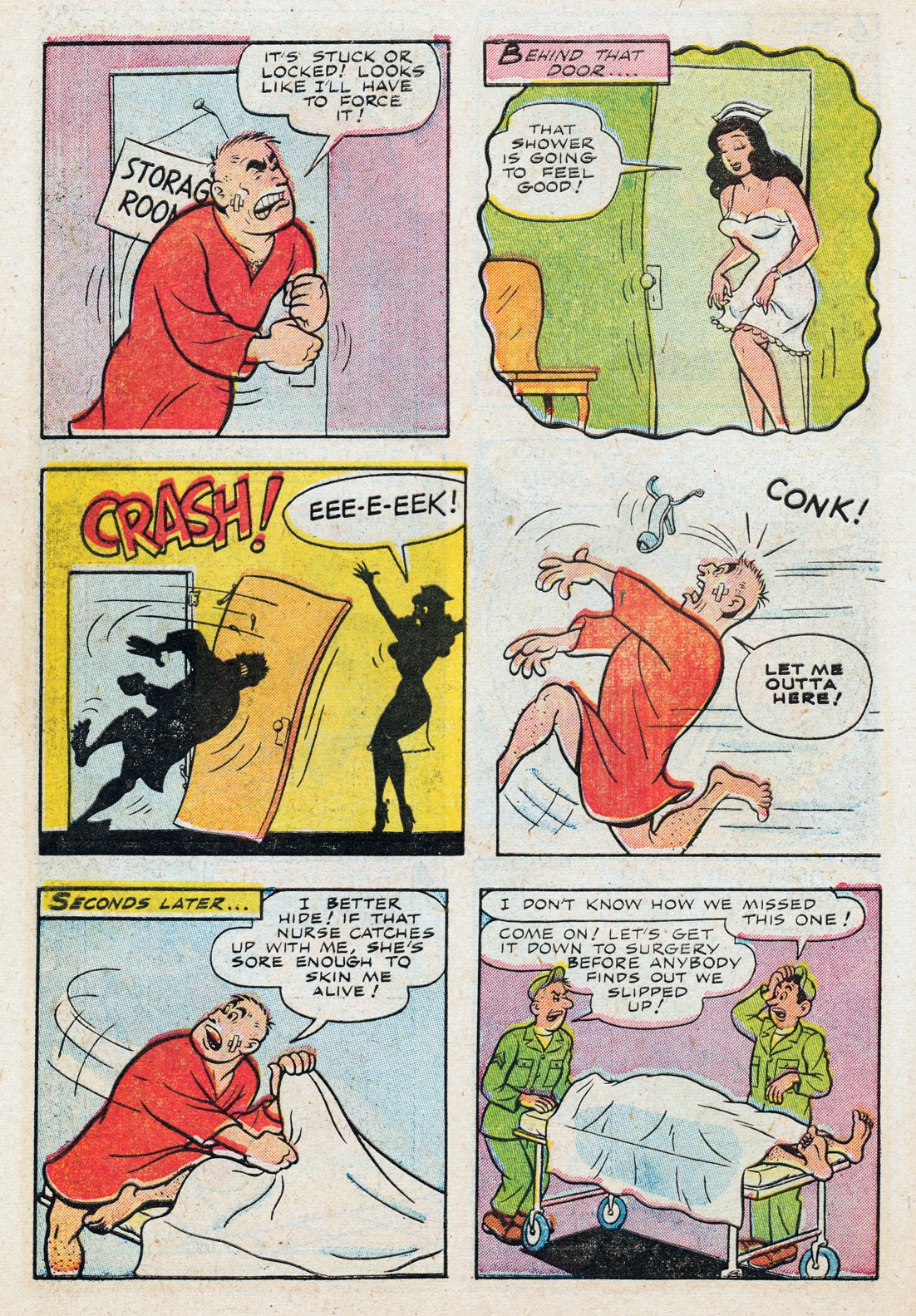
This 1952 Magazine Enterprises comic book, Dogface Dooley 3, has a cover that swipes one of Stan Lee's standard Nellie the Nurse gags, with the thermometer exploding as the patient (here Dogface Dooley) experiences a rising temperature in response to the visual stimulation offered by a sexy-looking nurse in a tight uniform. As is often the case, the cover is somewhat misleading, as the event depicted bears no resemblance to what actually happens in the stories inside. There is, however, one story that does include nurses, and certainly lives up to the reputation for objectification of nurses established by the cover.
It's not a particularly flattering image of soldiers either, but it is a funny book after all. The full comic has been uploaded to the Digital Comic Museum and is available at http://digitalcomicmuseum.com/index.php?dlid=14203.
Subscribe to:
Posts (Atom)