Showing posts with label diversity. Show all posts
Saturday, May 16, 2015
Early Black Comic Book Heroes: The Red Mask
You'll have to forgive my ignorance but it is only just recently that I learned of the character that appears, by some accounts, to have been the first Black hero in comics. He was created by someone who signed his name as George West, and originally appeared in newspapers running Syndicated Features comics strips in 1936. These strips were subsequently collected and reprinted in Best Comics published by Pines (Standard) beginning in November 1939, and lasting for only four issues. Note the landscape format, very unusual in comics.
That hero was the enigmatic Red Mask. Now if you have never encountered The Red Mask, as I hadn't until a few days ago, you may well be puzzled by the above cover of Best Comics #2. This is the only issue available online in the Digital Comic Museum, but considering its rarity, we should consider ourselves very fortunate that the DCM has even one. According to the Gerber Comics Photojournal scarcity index, between 21 and 50 copies are estimated to exist of issues #1 and #4, and there are no more than between 11 and 20 copies of #2 or #3 (these figures obtained from Michelle Nolan's 'Niche' on the CGC website and also from eBay).What you see on this cover of #2 above is The Red Mask depicted as a white person protecting a white female (Nina) and a young white male (Danny) from hostile native tribesmen. However, the character is most definitely intended to be Black, as evidenced by the cover of Best Comics #1 and by the strips themselves. Unfortunately there is some visual racist stereotyping of the Black native people in this comic.
The cover of Best Comics #1 is featured on Comic Vine and the Grand Comics Database, and if you go to either of those websites using the links provided, you will see that The Red Mask is most definitely a Black person. A complete understanding of this important comic is elusive, however, not just because of its rarity. The fact is that some of the pages have panels in which The Red Mask is colored white, sometimes as sort of half black, and in the majority that I can find he looks Black. As comic strip expert Allan Holtz points out, The Red Mask has wavy, non-African hair. Only 26 episodes of the strip were ever published, with the story left hanging, so we'll never know for sure what was going to be the eventual outcome. Holtz thinks that The Red Mask was most likely the white guy, Jason Armitage, who went missing a year previously, and whom the other white people in the story are searching for. Holtz's explanation for The Red Mask being black is that he has been in the jungle for a while and developed a deep tan.
However, I am inclined to believe that The Red Mask was intended to be the Black person he was portrayed as. The story is not necessarily set in Africa. We are told the setting is "the South Seas," and the action seems to be taking place initially on an island, Kaukura. So the fact that The Red Mask's hair is not African-looking isn't necessarily a problem. I also think that the explanation for the change in coloration of The Red Mask's skin on the covers of Best Comics #2, #3, & #4, and on the interior pages, were down to an inexperienced and/or uninformed colorist. After all, over 20 years later the same kind of error happened with the cover of Marvel's Sgt. Fury #1 - Gabriel Jones, the African American Howling Commando was depicted with white skin on that cover by mistake. Racist reactions to Best Comics could also have been the reason why a deliberate change in the Red Mask's color was made on the covers of the books after issue #1, and also on some interior pages.
The earliest episode of The Red Mask newspaper strip that's available in color on the internet is #6, which is posted on Allan Holtz's blog, The Stripper's Guide. This would have been reprinted in Best Comics #1, which had episodes 1 through 7. Best Comics #2 has episodes 8 through 13, and one can speculate that the remaining 13 episodes were split between issues #3 (probably episodes 14 through 20) and #4 (probably episodes 21 through 26). Since The Red Mask was the main feature in Best Comics, and the strip had ceased publication in newspapers prior to Best Comics reprinting them, one has to conclude that Pines/Standard had no intention of publishing more than 4 issues, that is, unless they had another main feature ready to take its place but the sales weren't good enough to justify continuing. Allan Holtz has the last episode, #26, on his blog, along with black and white microfiche images of episodes #1 and #2, as well as a color image of episode #20. Episodes 8 through 13 are as follows:
The story seems to be that Colonel Trent, along with Robert Fear and some other men, as well as Nina and Danny, came on the Colonel's yacht in search of Jason Armitage, who disappeared in the area a year before. The Red Mask is really Maui, chief of a native tribe. I can see why Allan Holtz thinks that ultimately we would have found out that Maui/The Red Mask is in fact Jason Armitage. Then there's the mysterious Grotto of Jewels, lair of the Sacred Monster. The action in the above pages seems to be occurring on two fronts: inland with The Red Mask's tribe, and with the 'Coastal Tribe,' who have captured the Colonel and the others.
Similarities with The Phantom, which also debuted in newspapers in 1936, have been noted, but of course The Phantom is still going strong today, and he is most definitely a white man. The Red Mask has slipped into obscurity until recently. We'll likely never know the truth behind the story of The Red Mask, but there is certainly a case for him being the first Black hero in comics!
Friday, May 1, 2015
Spaghetti Western Fumetti: Tex
While western comics went out of fashion in the late 1970s here in America, in Italy the genre is not only alive and healthy, but thriving. The top-selling western, and one of the most popular comics in Italy, is the long-running title, Tex. Ongoing since 1948, with current print runs in excess of 200,000 copies per issue, it lasted far longer than even the longest running American western titles, such as DC's Western Comics or Marvel's Kid Colt! At its peak it was selling 700,000 per month! There is actually nothing comparable to this giant in the western genre in the USA and I'm guessing anywhere else. Ironically, the characters in Tex present a far more accurate picture of the true diversity of the Wild West than American western comics ever did. We see Black, Mexican, American Indian, and white cowboys working together, as it was in the real history of the West, but not as most twentieth century media portrayed it. Moreover, these characters are presented respectfully, with some hint at the true depth and complexity of American Indian culture. Racism is not prominent in this Wild West, just as in the real West of America, when it was beyond the borders of the Union, and even up until Jim Crow began to bite, when Black people could start a new life relatively less encumbered by the oppression prevalent in the States.
And these are not small comics, in terms of pages. Not the more modern issues anyway. They're each as long as an American graphic novel! Tex was originally created by Giovanni Luigi Bonelli (writer) and Aurelio Galleppini (artist). I believe the editor, Sergio Bonelli, is quite a celebrity in Italy. Of the dozens of artists who have worked on the book during its 67 year history, only one appears to be American - the great Joe Kubert was the guest artist on Tex Special #15 (I'm getting my information from the Italian Wikipedia at this point!).
Tex Willer is a leader in the Navajo tribe, having married a Navajo woman, Lilyth. So Arizona of the 1880s is the main setting in the original comics, but over the years stories have taken place in surrounding areas such as New Mexico and Texas, and far further afield places like Alaska and Colombia.
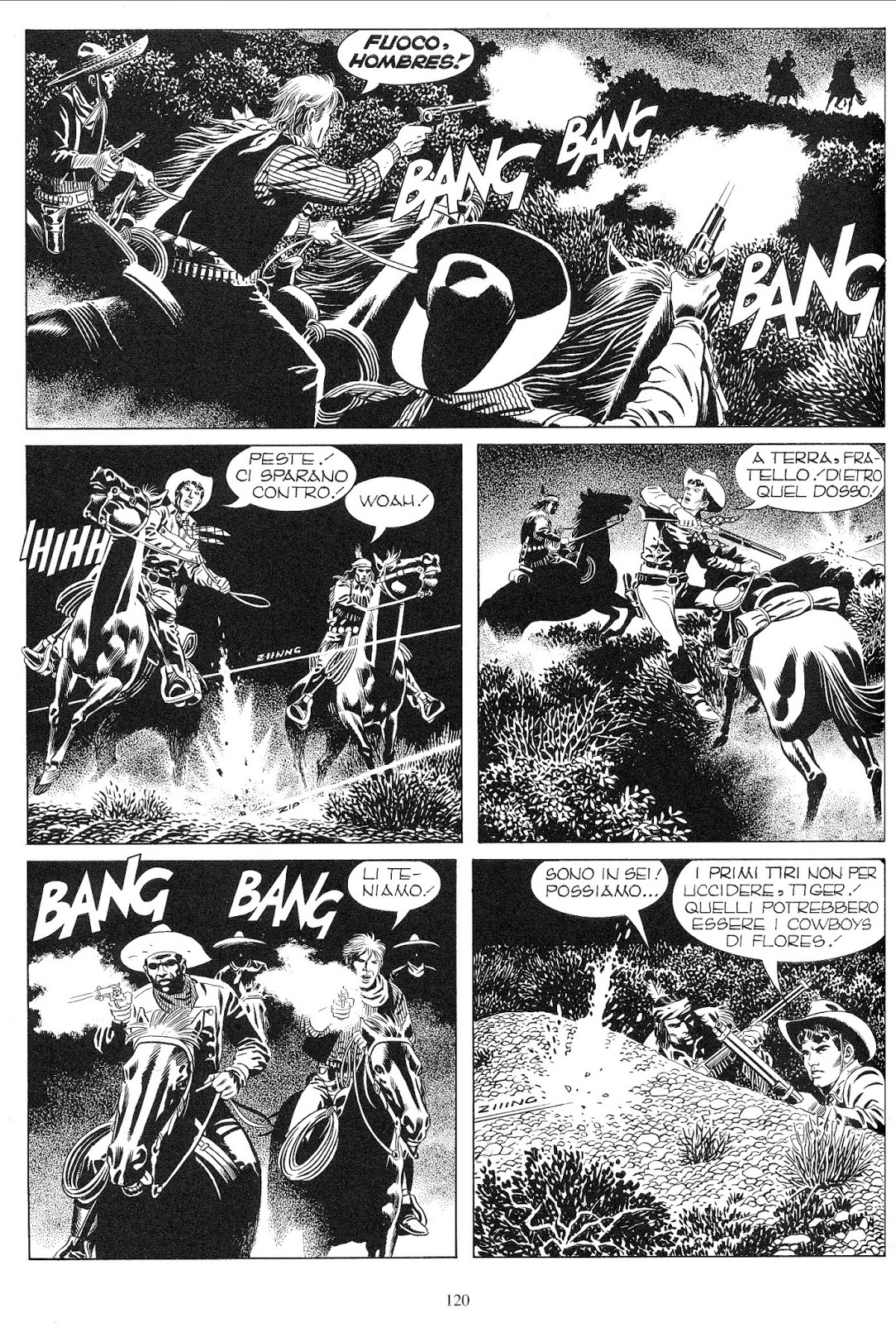
Here's a couple of examples that I collected on recent trips to Venice. The first is one that I found in a second hand bookstore. It is a large, 240 page, Tex Annual #27 from 2012. Only the covers are in color, but the interior black and white art is exquisite. The cover and interior art of this one is by Fabio Civitelli, the story by Mauro Boselli. The title of the story literally seems to be "The Ride of the Dead," but it could be more like "The Trail of the Dead."
My Italian is practically non-existent, so I can only actually read the comic using Google Translate, a very slow and unsure process. Nevertheless, I've picked a couple of interesting looking pages (120 & 121) and tried to translate. Here goes:
Cowboy #1: Fire, hombres!
Tex: Vermin! They're shooting at us! On the ground, brother! Behind that rock!
Cowboy #1: We've got them!
Tiger Jack: There's six of them! We can't...
Tex: Those first shots were meant to kill, Tiger! Those could be Flores' cowboys!
Tiger Jack: Bah! In my opinion this is a waste of lead!
Cowboy #1: Lightning!
Tex: Stop! Or we'll start getting serious!
Cowboy #2: Madre de Dios!
Cowboy #1: They shoot like devils! What do we do, Ray?
Ray: There's not much we can do! We went in without thinking and now we're at their mercy! Let's hear what they have to say!
Tex: Are you the cowboys from "Agua Escondidas" ["Hidden Water"]?
Over the next few pages Tex and his blood brother, the Navajo Tiger Jack, appear to make friends with this group of initially hostile cowboys. I didn't try to translate these next example pages (144 & 145) but a lot can be inferred from the visuals:
That annual had magazine-size pages. The monthly issues of Tex, however, are Italian digest-size, a little bit larger than the American digest (e.g. the Archie digests). Here's an excerpt from Tex Monthly #639 from January, 2014. The title is "In the Slums of San Francisco." My translation here is probably worse than the one above, but hopefully gives some idea as to what is being said.
Some more of the main or support characters in the series are featured here. There's Tex's son, Kit Willer, and also Lefty Potrero, an ex-fighter who owns the Hercules Gymnasium in San Francisco (in the story).
Tiger Jack: For Manito! They're talking about a woman hostage! Who can she be? I have to go back to warn Kit and Donen! But not now! People are coming!
Strongman#1: Here's the place!
Lefty: A real den of rats!
Strongman#2: Don't wait to... [totally unsure what this means]
Lefty: Quiet boys! You have to use your brain here, not your muscles!
Strongman#2 Uh!
Lefty: If we're not careful, these particular rodents would scram under our noses... and I don't think in that case Tex would be very grateful.
Strongman#1 [Bingo]: But if we go in acting normal and look around?
Lefty: Mmm...
Donen: You can't tell them what to do, Kit. The success of the plan depends on whether you and I can always stay in the shadows!
Kit: And are your motives true, Donen? Thirst for adventure and desire for revenge? Or because you are ready to join the army of God?
Donen: Why did you agree to it if you doubt me so much, Kit?
Kit: My father trusts you... and then... you're not the only one who loves the thrill of the unexpected, amigo!
Lefty: Okay! You're right, Bingo! Enter in groups of two or three to avoid attracting too much attention... and keep your eyes peeled for those four in the description, guys!
Strongman#3: Okay, Lefty!
Well, I hope you all found something interesting in this introduction to an Italian institution! For further introductory reading on Italian fumetti please check out the following Out Of This World blog posts:
On the Trail of Fumetti
Spaghetti Western Fumetti: Lanciostory A.5 #26 - "Come Coda di Volpe Divenne Bandito"
Out Of This World leaves you with a selection of Tex covers from the 1960s and 70s. Enjoy!
And these are not small comics, in terms of pages. Not the more modern issues anyway. They're each as long as an American graphic novel! Tex was originally created by Giovanni Luigi Bonelli (writer) and Aurelio Galleppini (artist). I believe the editor, Sergio Bonelli, is quite a celebrity in Italy. Of the dozens of artists who have worked on the book during its 67 year history, only one appears to be American - the great Joe Kubert was the guest artist on Tex Special #15 (I'm getting my information from the Italian Wikipedia at this point!).
Tex Willer is a leader in the Navajo tribe, having married a Navajo woman, Lilyth. So Arizona of the 1880s is the main setting in the original comics, but over the years stories have taken place in surrounding areas such as New Mexico and Texas, and far further afield places like Alaska and Colombia.
Here's a couple of examples that I collected on recent trips to Venice. The first is one that I found in a second hand bookstore. It is a large, 240 page, Tex Annual #27 from 2012. Only the covers are in color, but the interior black and white art is exquisite. The cover and interior art of this one is by Fabio Civitelli, the story by Mauro Boselli. The title of the story literally seems to be "The Ride of the Dead," but it could be more like "The Trail of the Dead."
My Italian is practically non-existent, so I can only actually read the comic using Google Translate, a very slow and unsure process. Nevertheless, I've picked a couple of interesting looking pages (120 & 121) and tried to translate. Here goes:
Tex: Vermin! They're shooting at us! On the ground, brother! Behind that rock!
Cowboy #1: We've got them!
Tiger Jack: There's six of them! We can't...
Tex: Those first shots were meant to kill, Tiger! Those could be Flores' cowboys!
Tiger Jack: Bah! In my opinion this is a waste of lead!
Cowboy #1: Lightning!
Tex: Stop! Or we'll start getting serious!
Cowboy #2: Madre de Dios!
Cowboy #1: They shoot like devils! What do we do, Ray?
Ray: There's not much we can do! We went in without thinking and now we're at their mercy! Let's hear what they have to say!
Tex: Are you the cowboys from "Agua Escondidas" ["Hidden Water"]?
Over the next few pages Tex and his blood brother, the Navajo Tiger Jack, appear to make friends with this group of initially hostile cowboys. I didn't try to translate these next example pages (144 & 145) but a lot can be inferred from the visuals:
That annual had magazine-size pages. The monthly issues of Tex, however, are Italian digest-size, a little bit larger than the American digest (e.g. the Archie digests). Here's an excerpt from Tex Monthly #639 from January, 2014. The title is "In the Slums of San Francisco." My translation here is probably worse than the one above, but hopefully gives some idea as to what is being said.
Some more of the main or support characters in the series are featured here. There's Tex's son, Kit Willer, and also Lefty Potrero, an ex-fighter who owns the Hercules Gymnasium in San Francisco (in the story).
Tiger Jack: For Manito! They're talking about a woman hostage! Who can she be? I have to go back to warn Kit and Donen! But not now! People are coming!
Strongman#1: Here's the place!
Lefty: A real den of rats!
Strongman#2: Don't wait to... [totally unsure what this means]
Lefty: Quiet boys! You have to use your brain here, not your muscles!
Strongman#2 Uh!
Lefty: If we're not careful, these particular rodents would scram under our noses... and I don't think in that case Tex would be very grateful.
Strongman#1 [Bingo]: But if we go in acting normal and look around?
Lefty: Mmm...
---------------------------------------------------------
Kit: That's Lefty Potrero and his strongmen from the Gym! What the hell are they doing? If they all go in there together they will arouse suspicion!Donen: You can't tell them what to do, Kit. The success of the plan depends on whether you and I can always stay in the shadows!
Kit: And are your motives true, Donen? Thirst for adventure and desire for revenge? Or because you are ready to join the army of God?
Donen: Why did you agree to it if you doubt me so much, Kit?
Kit: My father trusts you... and then... you're not the only one who loves the thrill of the unexpected, amigo!
Lefty: Okay! You're right, Bingo! Enter in groups of two or three to avoid attracting too much attention... and keep your eyes peeled for those four in the description, guys!
Strongman#3: Okay, Lefty!
---------------------------------------------------------
Notice how the whispering on p.58 between Kit and Donen is indicated by word balloons with a hashed line!Well, I hope you all found something interesting in this introduction to an Italian institution! For further introductory reading on Italian fumetti please check out the following Out Of This World blog posts:
On the Trail of Fumetti
Spaghetti Western Fumetti: Lanciostory A.5 #26 - "Come Coda di Volpe Divenne Bandito"
Out Of This World leaves you with a selection of Tex covers from the 1960s and 70s. Enjoy!
Tex #69
Tex #91
Tex #99
Tex #103
Tex #104
Tex #107
Tex #108
Tex #151
Thursday, January 8, 2015
Diversity in Comics: Friday on Sunday
Jim Lawrence and Jorge LongarĂ³n's Friday Foster newspaper strip ran for about four years and featured the exploits of the vivacious photographer, whose life was a constant stream of drama and events. Friday Foster was the first syndicated strip to feature an African American female lead character, although Black female leads did exist decades before in the form of, for example, Torchy Brown in Heartbeats by Jackie Ormes, which was printed in the Pittsburgh Courier. But Friday Foster represents a real leap forward on the road towards an accurate depiction of diversity in American comics, besides being a quality strip with fabulous artwork.
The Friday Foster stories included a romantic component, and the strip could be argued to belong to the romance genre as much as any other. The above example is from the Chicago Tribune in the strip's first year - the date is 11/29/1970. Friday gets out of Harlem and ends up being something of a globetrotter, and her adventures are not restricted to being a photographer. She gets involved in all kinds of goings on. Here's a couple of consecutive Sunday strips from 1971 (3/14 and 3/21) in which Friday is unknowingly getting herself enmeshed with members of the criminal underworld:
In these next excerpts, from 1972, Friday encounters a big shot Broadway actor, Dirk Maroon, while on a fashion shoot in the Caribbean (07/30):
By the following Sunday, Friday is resisting Dirk's charms, even though those around her seem to think he's a great guy:
But... poor Friday! By the end of the month she's caved in to the pressure, and allowed herself to fall for the player's charms, only to have her heart broken:
The 1972 Sunday strips are too large for my scanner so that's why I'm only showing part of each. These last few illustrate nicely how Friday Foster fits into the romance genre. The single Dell comic book version of Friday Foster was featured a little under a year ago in the premier romance blog, Sequential Crush, and I direct readers there for Jacque Nodell's coverage of that Joe Gill/Jack Sparling rarity.
I can only echo Jacque's lament that there was just the one comic book, and add that there is no reprint collection of these superb newspaper strips either - it's long overdue Dark Horse or Fantagraphics, if you're listening!!! Collecting the comic strips is an expensive business. I haven't come across any of the daily strips for sale on eBay, but the Sundays go for around $3 to $5 each, or more!
There's more information about the strip here and there on the Internet. For example:
Dave Karlan's Original Art Blog
Some nice example of the original art are featured on the comicartfans galleries and marketplace:
comicartfans
Anyway, I hope you all enjoyed savoring the wonderful artwork of Jorge LongarĂ³n. 'Til next time...
Monday, May 19, 2014
Diversity in Comics: The Little Rascals
The Little Rascals have a history that stretched from the earliest Hal Roach Our Gang short movies made in 1922, through the last of those shot in 1944, and through the 1950s and beyond with the series adapted for television and re-titled The Little Rascals. Dell Comics adapted the original movies with their 1940s Our Gang series of comic books, which included highly sought after renderings of popular cartoons at the time - Tom and Jerry, Benny the Burro, etc. - by such celebrated artists as Carl Barks and Walt Kelly. In the mid-1950s Dell produced the comic book version of The Little Rascals, that ran into the early 1960s. The importance of these Dell comics, and the movies they represent, is the fact that the Rascals are an integrated group of neighborhood kids, presented in popular media during the segregated phase of American society. And The Rascals are not without controversy. Some accused them of containing stereotyping of minorities, and television versions were later edited and scenes cut to remove offending material. It is difficult to say whether or not there was actual racist intent, due to the unfortunate norms of the time when the films were made. The fact that the cast included African American children on an equal footing with their white peers was a positive move. Did any racist elements carry over into the comics - again, difficult to say. Take a look at these two stories from The Little Rascals #1137 (Apr-May 1960) and see if you think Farina and Buckwheat are respectfully portrayed or not.The Little Rascals series is post-Code, so there is far less likelihood that any demeaning stereotyping of minorities would be present. The original Our Gang series has been reprinted in a very nice four-volume set by Fantagraphics Books - as I was not so interested in the funny animal content of the original comics I saved myself a bundle by buying the reprint books, which only contain the Our Gang stories.
Monday, December 30, 2013
One Tiny Step for Humankind
In the mid-1950s there were no regular, respectfully-portrayed African American comic book characters in mainstream American comic books, except for one. According to former Harvey Comics editor, Sid Jacobson, "Tiny was done consciously by us... our group... were socially conscious. Audrey was the only comic then with a black character. We even got an urban award for it" (Beck, 2009), p.11). According to Dark Horse's Harvey Comics Classics Volume Five: The Harvey Girls, Tiny's first appearance was in Little Audrey #30 in June 1953. This is apparently an error, however. In the same book there is a reprint of the Little Audrey story "Carpet Bagger" from Little Audrey #28, published in Feb 1953, which features Tiny. This appears to me to be the earliest story in which Tiny appears. Tiny is not featured at all in Little Audrey #25 (the first Harvey issue) and #26. The only story I have access to from Little Audrey #27 is "Prize Pup" reprinted in the Dark Horse book, and Tiny is not in that. So at this point it seems that Tiny's debut was in Feb 1953! Tiny actually featured on four covers in the original Little Audrey series - issues #35-#38. The only other cover to feature Tiny was Little Audrey TV Funtime #3 in the early 1960s. As has been noted by others, collecting a complete set of any Harvey kids' title is more difficult that putting together a complete set of Superman or Batman - they're just so rare - and finding precise information about these important publications is also very difficult.
I suppose you could call that an example of slapstick humor! That and the next one illustrate Tiny's uncanny ability to 'fall on his feet'. In "Hair Today" you saw Tiny rewarded for being a good kid and accidentally helping others in the process. Tiny is a 'glass half full' guy most of the time - positive, happy - his childish innocence helps, and as you'll see in "Get Lost', Tiny often comes to everyone's rescue.
You can't buy new Harvey Comics any more - that hasn't been possible for a long time. But they still hold appeal not just for old comic fans like myself, but also the younger generation. I ran a test, and gave my 8 year old granddaughter a pile of over 100 old Harvey Comics, mostly Little Audrey, Little Dot, Richie Rich, and an assortment of others. It didn't seem to matter to her that the kids in the stories didn't have cell phones, computers, or play video games. She sat and read through the whole lot in a matter of weeks when she was round my house, and enjoyed them all. To people of my generation Harvey Comics were a significant influence, providing relatively wholesome conditioning. Harvey Comics normalized diversity at a time when prejudice was rampant. They empowered their young female readers by presenting strong, assertive, independent female protagonists like Little Audrey. They adhered to the Comics Code and produced comics that parents could trust at a time when comic books were regarded with suspicion.The only recent publications featuring Harvey Comics are the fabulous and inexpensive reprint books by Dark Horse that I mentioned at the beginning - there are several volumes but just the one that features Little Audrey and Tiny. I highly recommend purchasing this one and the entire series.
But back to my original reason for posting about Tiny. There were a few respectful representations of African Americans in comics during the 1940s and into the early 50s, even some regularly featured characters. But by 1953 they were gone. Tiny was the only one for a while, then in the late-50s Dell re-introduced Our Gang as The Little Rascals, mirroring the re-packaging of the Hal Roach movies for TV. But Tiny was a pioneering move on the part of Harvey Comics. Tiny had his own feature, unlike the African American members of Our Gang/The Little Rascals, or John Smith, assistant to Balbo the Boy Magician in Fawcett's Master Comics. Harvey Comics' efforts at enlightenment during what was in some ways a bleak period in this country's history need recognizing and celebrating.
Subscribe to:
Posts (Atom)