Showing posts with label Bob Kanigher. Show all posts

Saturday, December 28, 2013

The Friendly Skies: Young Romance 127 - "Another Face, Another Love"

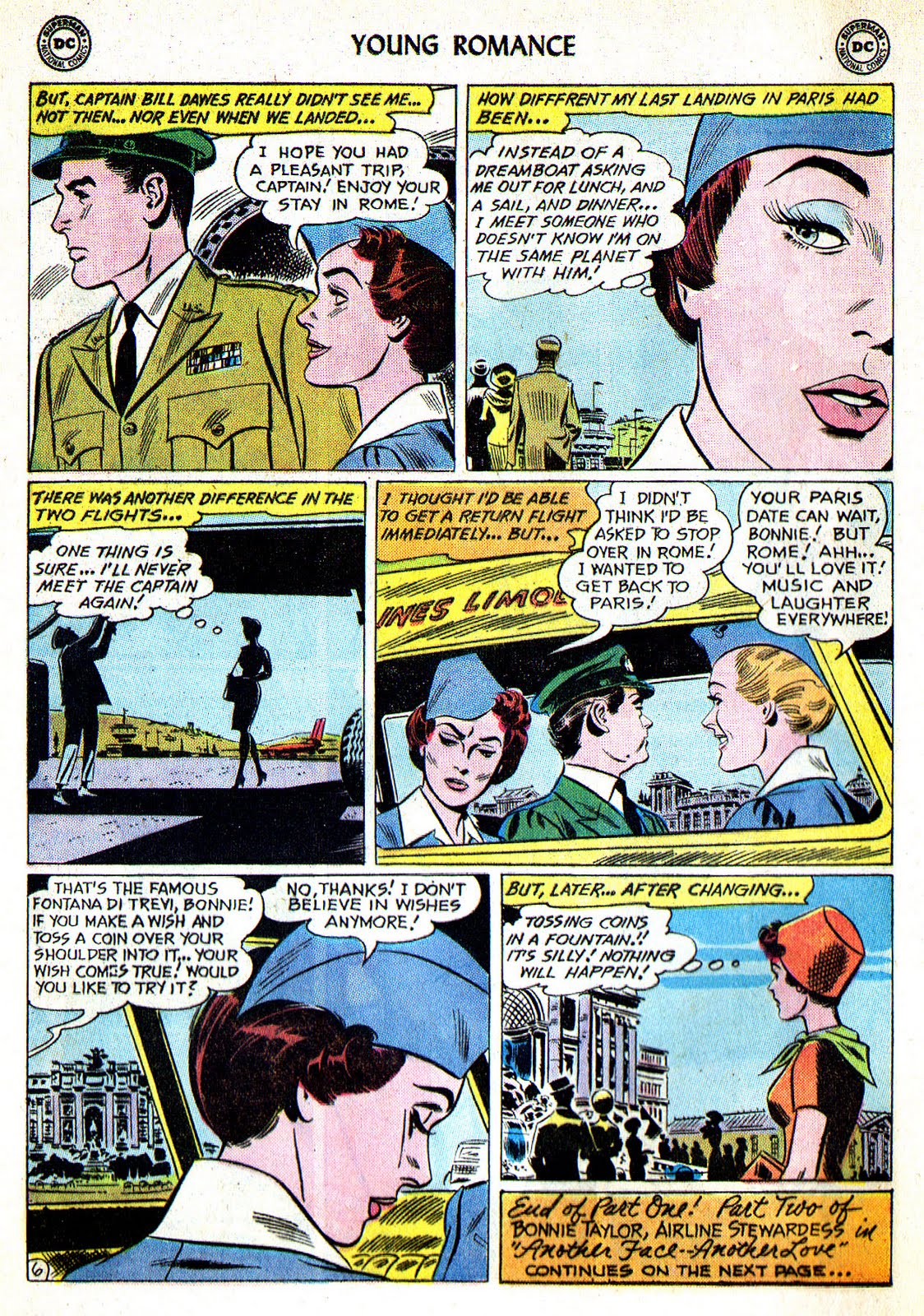
Although I have a number of these Bonnie Taylor comics in my collection, I don't have this one, the scan of which I received from another collector. The Bonnie Taylor story suggests what life is like for a woman constantly on the move in the job of an airline stewardess. Drawn by John Romita Sr. and written by Bob Kanigher, it represents the product of a high quality team working for DC at the time (mid-1960s).

'Career girl' or 'working girl' stories are fairly common in romance comics, and tended to highlight the 'career-love dilemma', most amply demonstrated by nursing romance comics, numerous examples of which can be found on this blog. In comics, nurses were exposed to an endless barrage of handsome and/or wealthy patients, as well as doctors and interns. For airline stewardesses it was passengers and pilots that provided the potential love interest, or handsome strangers in the many ports of call.

By the 1960s, Charlton Comics were the principle purveyors of career girl romance stories, with numerous nursing romance books as well as Career Girl Romances itself. Marvel adapted their previously more cartoon-like and humorous Millie the Model and Patsy Walker titles, making them more like romance titles, and DC took the bold step of orienting some of their romance books to career girls, creating ongoing features about specific characters. In Young Love it was Mary Robin, RN, also produced by Kanigher and Romita, Sr., and in Young Romance it was Bonnie Taylor in her very PanAm-ish blue uniform.

Interesting studies can be found on the traditional airline stewardess of yore. Come Fly With Us! A Global History of the Airline Hostess, Femininity in Flight: A History of Flight Attendants, and Working the Skies: The Fast-Paced, Disorienting World of the Flight Attendant are some good examples, as well as the well-researched but unfortunately canceled TV Series Pan-Am. Of note on the cover of Young Romance #127 above, the first issue to feature Bonnie Taylor, is the caption that reads, "Meet Bonnie Taylor, the lovely airline stewardess, who flies in and out of romantic adventures," suggesting that Bonnie's relationships are unlikely to be long-lasting.

Just as with the Mary Robin, RN stories, these Bonnie Taylor romances are written as a kind of diary. In Young Love the Mary Robin stories actually take the form of a diary written by Mary, but with Bonnie Taylor it is more like she is the narrator of her own tale detailing the euphoria and heartache of her fleeting encounters. So here's the story that introduced Bonnie Taylor to the eager 1960s readership of Young Romance:

   
It's interesting that Bonnie is definitely on the look out for romantic opportunities. Also interesting is the implication that Bonnie's job will drag her away from any romance she does find. In the case of the Captain, she lost out to a girl who is located in one place. The good old career-love dilemma for the working girl.

Thursday, March 1, 2012

Social History in Comics: Blitzkrieg 2 - "Walls of Blood"


Robert Kanigher, a long-time writer for DC, can be observed over his career to have been a name more often associated with anti-racist messages in comics than other writers of the time, and he often teamed with artist Joe Kubert on DC's war books. Blitzkrieg was a rather controversial book with the publisher (Joe Kubert, personal communication) that took a look at World War II from a Nazi perspective. This issue (#3, Mar-April 1976) is particularly hard-hitting in the way it depicts the callous slaughter of Polish Jews by inhuman Nazis. With a cover by Joe Kubert and interior art by Ric Estrada, the artwork is meritorious. The comic is one of a number of anti-racist war comics published by DC through the 1960s and well into the 1970s. Overall, when this particular body of work by Kanigher is examined, it is possible to see a theme of equating racism against African Americans with the anti-Semitism and other prejudices of the Nazis, the bottom line being that okay we despise, and rightfully so, the racist atrocities committed by the Nazis, and this is an incompatible position to take if we don't simultaneously condemn racism against African Americans and racism generally. It's also the approach adopted by Stan Lee and Jack Kirby at Marvel (see especially Sgt. Fury and His Howling Commandos #6). I found this issue of Blitzkrieg a bit uncomfortable to read because of the reality behind the story - it's painful to even begin contemplating the human suffering that really did take place at that time.


Heavy stuff, and it barely begins to convey the full horror of what went down, even though as a piece of popular media, it does a lot to make the reader think about the Holocaust, more than most material from the mid-1970s.

Sunday, February 20, 2011

Early Black Comic Book Heroes: Mal Duncan (1/4)


Mal Duncan (aka the New Guardian, Hornblower) is actually one of DC's earliest black superheroes. Appearing first in Teen Titans (series 1), he joined the group at a point where they had sworn off use of their super powers, after accidentally causing the death of a great social reformer (issue 25). The group takes on secret work under the guidance of the world's richest man, Mr. Jupiter, having to first prove themselves in some tests, which is where the story, "A Penny For a Black Star" (Mar-Apr 1970), in Teen Titans 26, picks up (story by Bob Kanigher, art Nick Cardy). First, a quick summary from issue 27:


The Titans pass the physical, and are then sent to Hell's Corner, a tough inner-city environment, to fend for themselves with just a penny. They use their pennies to buy drinks from a little girl, and in doing so attract the attention of a local street gang, Hell's Hawks, whose turf they have unknowingly blundered into.


The gang starts to rough up the little girl, who happens to be Mal Duncan's younger sister. The Titans, reluctant to break their oath of non-super power use, don't look like they're going to be any help.


Just as well that Mal happens along and jumps in to defend his sister. Seeing him vastly outnumbered, the Titans act, but without going 'super'.


The gang is seen off for now, but Mal is under no illusion that they're finished. He also notices that the Titans don't really have a clue regarding the environment they've wandered into.


Wonder Girl and Lilith do as they've been instructed by Jupiter, and go looking for work, which they find in a local clothing store. The boys end up taking on some youth work.


This brings the Titans back into contact with Mal, who is entered for a boxing match. The Titans first, however, start getting anonymous threats.


In the ring Mal is facing the leader of the evil Hawks gang - it's a real grudge match, which Mal eventually wins. In the changing rooms, after the contest, the gang seeks revenge and has Mal trapped. Now it's the Titans' turn to come to Mal's rescue.


Mal points the Titans in the direction of some evening relaxation, and they insist he accompanies them. Mal is expecting inferior treatment of the kind he's used to receiving from racist whites in his area, and is pleasantly surprised when he is not only accepted as part of the group, but also attracts interest from Lilith. The Titans ask Mal if he'd like to join their secret project, and upon their recommendation, Jupiter puts him through the necessary test.


Mal feels inadequate, like he doesn't deserve to be part of the group, especially since he has no super powers. Although seemingly rather illogical to the reader, Mal figures he can prove his worth by sneaking aboard a one-way rocket trip to Venus, because a live astronaut would be able to increase the scientific results reaped by the mission.


The Titans and Mr. Jupiter are, of course, not going to let Mal sacrifice his life for some data, and so enact a scheme to retrieve him, in issue 27, "Nightmare in Space" (May-June 1970).


The Titans set off on the rescue mission, leaving part of their crew on the Moon, where a whole other adventure, involving some friendly aliens, occurs. Those still in space rendezvous with Mal's Venus probe.


One tricky rescue later, and the command module must now reunite with the group from the lunar surface. All back together, the Titans head for home and more adventures.


Mal became a regular member of the Teen Titans for the remainder of the first series, with some stories featuring him in a minor way, and others focusing wholly or partly on him. The remaining three Out Of This World posts on Mal will cover the main details of his introduction into the DC universe in the early to mid-1970s, with an analysis of the character as he had developed by the final cancellation of the original Teen Titans comic.