Showing posts with label Digital Comic Museum. Show all posts
Saturday, May 16, 2015
Early Black Comic Book Heroes: The Red Mask
You'll have to forgive my ignorance but it is only just recently that I learned of the character that appears, by some accounts, to have been the first Black hero in comics. He was created by someone who signed his name as George West, and originally appeared in newspapers running Syndicated Features comics strips in 1936. These strips were subsequently collected and reprinted in Best Comics published by Pines (Standard) beginning in November 1939, and lasting for only four issues. Note the landscape format, very unusual in comics.
That hero was the enigmatic Red Mask. Now if you have never encountered The Red Mask, as I hadn't until a few days ago, you may well be puzzled by the above cover of Best Comics #2. This is the only issue available online in the Digital Comic Museum, but considering its rarity, we should consider ourselves very fortunate that the DCM has even one. According to the Gerber Comics Photojournal scarcity index, between 21 and 50 copies are estimated to exist of issues #1 and #4, and there are no more than between 11 and 20 copies of #2 or #3 (these figures obtained from Michelle Nolan's 'Niche' on the CGC website and also from eBay).What you see on this cover of #2 above is The Red Mask depicted as a white person protecting a white female (Nina) and a young white male (Danny) from hostile native tribesmen. However, the character is most definitely intended to be Black, as evidenced by the cover of Best Comics #1 and by the strips themselves. Unfortunately there is some visual racist stereotyping of the Black native people in this comic.
The cover of Best Comics #1 is featured on Comic Vine and the Grand Comics Database, and if you go to either of those websites using the links provided, you will see that The Red Mask is most definitely a Black person. A complete understanding of this important comic is elusive, however, not just because of its rarity. The fact is that some of the pages have panels in which The Red Mask is colored white, sometimes as sort of half black, and in the majority that I can find he looks Black. As comic strip expert Allan Holtz points out, The Red Mask has wavy, non-African hair. Only 26 episodes of the strip were ever published, with the story left hanging, so we'll never know for sure what was going to be the eventual outcome. Holtz thinks that The Red Mask was most likely the white guy, Jason Armitage, who went missing a year previously, and whom the other white people in the story are searching for. Holtz's explanation for The Red Mask being black is that he has been in the jungle for a while and developed a deep tan.
However, I am inclined to believe that The Red Mask was intended to be the Black person he was portrayed as. The story is not necessarily set in Africa. We are told the setting is "the South Seas," and the action seems to be taking place initially on an island, Kaukura. So the fact that The Red Mask's hair is not African-looking isn't necessarily a problem. I also think that the explanation for the change in coloration of The Red Mask's skin on the covers of Best Comics #2, #3, & #4, and on the interior pages, were down to an inexperienced and/or uninformed colorist. After all, over 20 years later the same kind of error happened with the cover of Marvel's Sgt. Fury #1 - Gabriel Jones, the African American Howling Commando was depicted with white skin on that cover by mistake. Racist reactions to Best Comics could also have been the reason why a deliberate change in the Red Mask's color was made on the covers of the books after issue #1, and also on some interior pages.
The earliest episode of The Red Mask newspaper strip that's available in color on the internet is #6, which is posted on Allan Holtz's blog, The Stripper's Guide. This would have been reprinted in Best Comics #1, which had episodes 1 through 7. Best Comics #2 has episodes 8 through 13, and one can speculate that the remaining 13 episodes were split between issues #3 (probably episodes 14 through 20) and #4 (probably episodes 21 through 26). Since The Red Mask was the main feature in Best Comics, and the strip had ceased publication in newspapers prior to Best Comics reprinting them, one has to conclude that Pines/Standard had no intention of publishing more than 4 issues, that is, unless they had another main feature ready to take its place but the sales weren't good enough to justify continuing. Allan Holtz has the last episode, #26, on his blog, along with black and white microfiche images of episodes #1 and #2, as well as a color image of episode #20. Episodes 8 through 13 are as follows:
The story seems to be that Colonel Trent, along with Robert Fear and some other men, as well as Nina and Danny, came on the Colonel's yacht in search of Jason Armitage, who disappeared in the area a year before. The Red Mask is really Maui, chief of a native tribe. I can see why Allan Holtz thinks that ultimately we would have found out that Maui/The Red Mask is in fact Jason Armitage. Then there's the mysterious Grotto of Jewels, lair of the Sacred Monster. The action in the above pages seems to be occurring on two fronts: inland with The Red Mask's tribe, and with the 'Coastal Tribe,' who have captured the Colonel and the others.
Similarities with The Phantom, which also debuted in newspapers in 1936, have been noted, but of course The Phantom is still going strong today, and he is most definitely a white man. The Red Mask has slipped into obscurity until recently. We'll likely never know the truth behind the story of The Red Mask, but there is certainly a case for him being the first Black hero in comics!
Saturday, April 2, 2011
Nurses as Objects in Comics: Dogface Dooley 3 - "The Tattooed Sergeant"
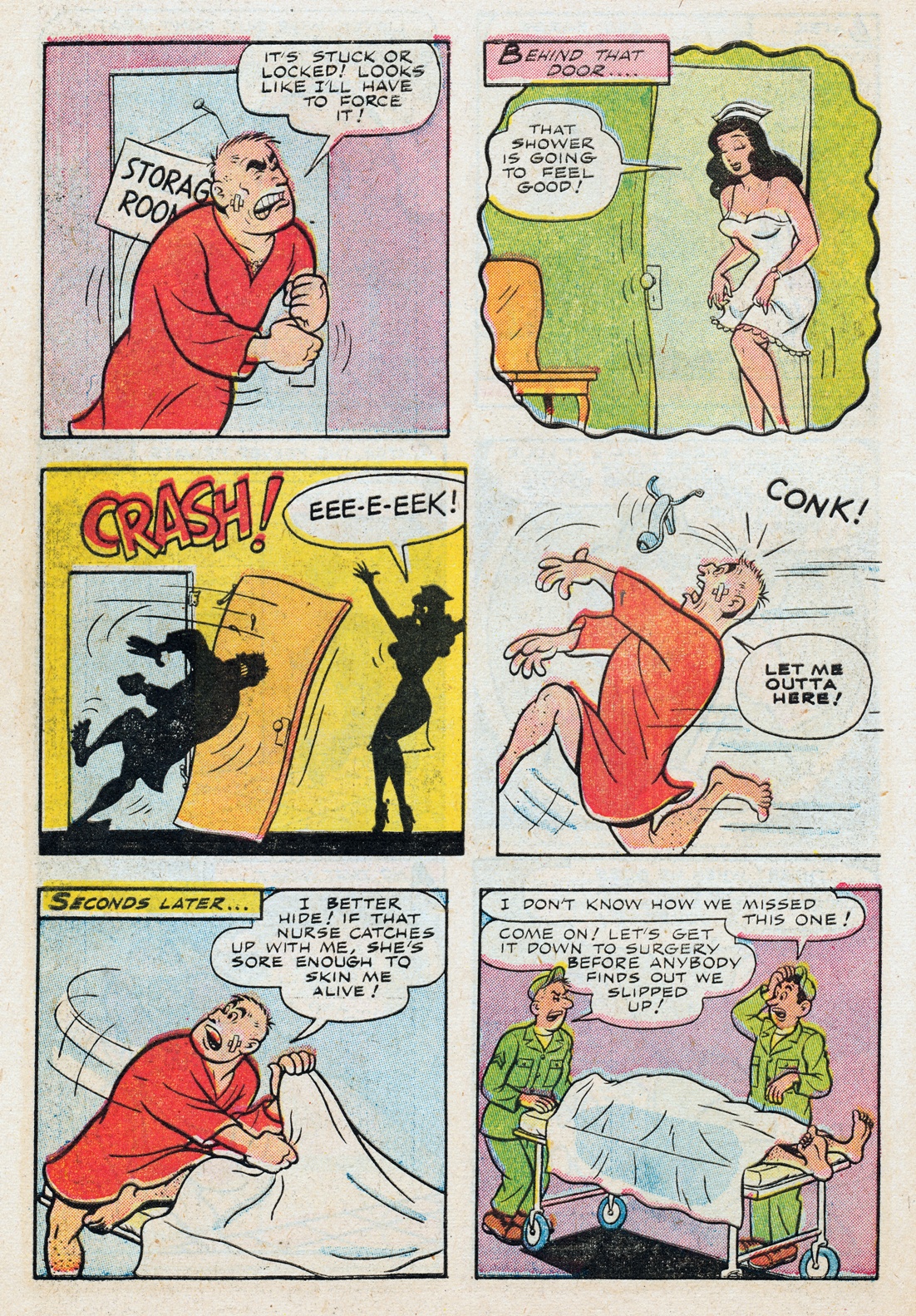
This 1952 Magazine Enterprises comic book, Dogface Dooley 3, has a cover that swipes one of Stan Lee's standard Nellie the Nurse gags, with the thermometer exploding as the patient (here Dogface Dooley) experiences a rising temperature in response to the visual stimulation offered by a sexy-looking nurse in a tight uniform. As is often the case, the cover is somewhat misleading, as the event depicted bears no resemblance to what actually happens in the stories inside. There is, however, one story that does include nurses, and certainly lives up to the reputation for objectification of nurses established by the cover.
It's not a particularly flattering image of soldiers either, but it is a funny book after all. The full comic has been uploaded to the Digital Comic Museum and is available at http://digitalcomicmuseum.com/index.php?dlid=14203.
Tuesday, March 1, 2011
Nurses as Objects in Comics: Joe Yank 12 - "The Battle of the Sexes"
Joe Yank was an early 50s Standard title of a kind of war comedy genre. Private Joe Yank and Sgt. Mike McGurk are the two main characters. I just acquired this comic, but I'm using pages from the scan available in the Digital Comic Museum. In this story, "Battle of the Sexes" by Ross Andru, we have a perfect example of image discrimination coupled with sexist exploitation of the female form. You'll also note the misleading cover, which depicts a scene that is not part of the actual story. What happens is McGurk gets hospitalized, and in the ward he encounters a nurse who doesn't fit the usual comic book stereotype of the pinup. With little else to do, and with a score to settle with Joe Yank, McGurk hatches a plan to make the Private experience some serious discomfort. He exploits the plain nurse's eagerness to find a man, and her unattractive features, to carry out his scheme.
Joe Yank turns up at the hospital to visit McGurk, and his first encounter with the nursing staff feeds his expectations, based on the kind of nurse image typically promoted by the male mind indulging in fantasy. This softens Joe Yank up for McGurk's ruse, and he buys it, hook, line, and sinker.
Joe Yank goes on his date, only to find he's been had. All he can think of from the moment he meets the man-hungry homely nurse is how to get away, and in the end he has to resort to some extreme measures.
I know it's a comedy designed most likely for male military readers, but I can't help feeling that there's something not right about the way the unattractive woman is made fun of and is also humiliated. Not all women and not all nurses look like Marilyn Monroe.
Kind of an unusual nurse tale that raises some interesting questions about attitudes towards women in the early 1950s.
Friday, April 16, 2010
Crime... and Medicine... Do Not Pay!
My proposal for a book chapter on the image of nurses in Containment Era comics was accepted by the editors with a deadline of August. So now the writing has to begin. I've already collected together a good number of actual romance comics with nurse stories, as well as some scanned issues from various sources, so there's more than enough material. I had wondered about buying a copy of Crime Does Not Pay 132 (March 1954) that I'd seen on eBay, with this 'tough dame' nurse cover by Charles Biro. Luckily I thought, "Why don't I check the Digital Comic Museum to see if they have a scan of it?" and bingo! One thing of note on the cover is the stereotypically red-headed nurse, wearing high heels in the operating theater, who's also handy with a gun! That's my kind of gal!
With this cover I was expecting the story to be something like that Marvel Night Nurse issue, featured recently on Jacque Nodell's Sequential Crush, where a gangster is receiving treatment in the hospital, a rival mobster comes to bump him off, and the nurse gets between the two, insisting that he'll kill the patient over her dead body. This crime cover may even have been the inspiration for the Night Nurse story, but alas, this issue is one of those where the actual story contents don't match the expectations generated by the cover illustration. The story and art are credited to Dick Rockwell by the Grand Comics Database. Instead, what we have is a rich patient in his last days, and a ne'er-do-well doctor obviously not getting paid the big bucks that medical men get nowadays. Envious of the old man's wealth, the doc cooks up a scheme to relieve the elderly citizen of some of his accumulated cash. Gaining his trust, the doctor acts as scribe for his will, for which the patient awards $50 in gratitude for this simple task (he could have bought 500 new comics with that much cash back then!). The doc isn't satisfied with fifty, and adds a couple of zeros after the patient has signed the will, deliberately avoiding contact with the old man's attorney Ed Harris.
At this point in the story the nurse character breezes in and out providing her care in the expected fashion.
Subsequently, with his plot in danger of being exposed, Dr. Burton does what any down-on-his-luck graduate of medical school would do - he bumps off his patient while the nurse is out of the room. She's suspicious though, and when Burton offers her $1000 to keep quiet, she knows he croaked the old guy and wants $3500 to keep schtum. Unfortunately for her she should have blown the whistle instead of thinking she stood to gain from the doctor's impropriety. He leads her along, her mind so bewildered by the thought of all that cash that she doesn't realize the danger she's in until it's far too late. One strangulation, a taxi ride with the body wrapped in a rug, and quick deposit in the mortuary later, Burton again thinks he's in the clear. What he doesn't know is that attorney Ed Harris is wise to him, having sent his assistant Tom Whitaker to spy on his conversation with the nurse. Tom's inability to read the circumstances allowed the doc time to kill the nurse, but a bit of further investigation reveals the doc's plan. The nurse's disfigured corpse is identified in the morgue, and ex-G-man Harris heads Burton off at the train station. Burton's for the chair, but the poor nurse paid a heavy price for giving in to temptation and exhibiting highly unethical conduct for a self-sacrificing angel.
The cover states that the contents of the book are all true crime stories, but this doctor is a little unbelievable - how on earth did he qualify with the kind of outlook he has? But then I guess it takes all sorts. Same with the nurse. This story is one of those that makes me thank Wertham, though, despite regretting that his testimony eventually resulted in the loss of the great EC. I'm not a fan of the crime genre, and this tale does slight the medical profession big time. As far as the image of nurses that this promotes - to begin with she's the polite and helpful provider of care we expect, but all of a sudden she transforms into an unscrupulous wannabe moll, abandoning her professional code of conduct seemingly at the drop of a hat. As such there is the suggestion that nurses will engage in extremely unethical conduct if the opportunity arises to benefit financially from doing so. Yuck!
Sunday, April 11, 2010
Romance Comic News: Golden Age Comic Downloads Reincarnated
Following its year (at least) of server problems, the UK's Golden Age Comic Downloads site, the world's #1 source of public domain golden age comic scans has been reincarnated as the Digital Comic Museum, and you'll be relieved to know that it functions normally.
Subscribe to:
Posts (Atom)