Wednesday, March 26, 2014

British Girls' Comics: Diana Annual 1975 and 1974 - Fabulous Four by Enrique Badia Romero

With every little bit I learn about the Spanish artists who worked for British and American comics in the 1960s and 70s, the more I realize that I don't know. These artists were/are simultaneously often very expert and accomplished in terms of the work they produced, but remain relatively poorly known, except for one or two. Enrique Badia Romero is one of the better known, but understanding even his work is complicated by the fact that he had a brother who was also a comic artist with a very similar style. Out Of This World has previously featured examples of Romero's work on British girls' annuals, and here's a couple more. First is the Fabulous Four story from the 1975 Diana Annual. When I try to define what it is that makes it Romero, I gravitate to the bushy eyelashes, the wisps of out-of-control hair, the liberally-applied eye shadow, and the pouting lips. But as those of you who like the work of Spanish artists will know, Romero isn't the only one whose women are rendered in this fashion. We're sometimes down to very subtle differences in the 'Spanish' or 'Catalan' style. And with these artists often not signing their work, the problem can get complex. So I have to say that I think, I'm pretty sure, this is Enrique Badia Romero, but I can't be 100% sure unless David Roach agrees! One thing is for sure, 'Spanish' artists deserve wider recognition for the work they did in Britain and the USA.


Now here's the 1974 Diana Annual Fabulous Four story. Was it the first? I don't know. The art looks similar to the 1975 story, but different at the same time. Does it represent an earlier phase in the evolution of the same artist? Is it more restrained, deliberately, because the artist was attempting to test the water? The characters certainly look younger. Is it by Romero's brother? Different inker? What do you think?


I don't have any more Diana annuals, so I think that's the last we'll be looking at the Fabulous Four here on Out Of This World. But watch out for more work by Spanish artists in upcoming posts.

Saturday, February 8, 2014

Enrique Badia Romero - Axa, from Il Mago #96, March 1980

Enrique Badia Romero is best known for his newspaper strips, especially Modesty Blaise. His work on Axa probably comes in second in terms of recognition, but as you can see from the examples below, it's superb. These are three pages from a section of newspaper strip reprints in an Italian fumetto called Il Mago from around about 1980. There are (or should I say were) reprint collections available in English and some are still obtainable at non-astronomical prices on Amazon, but I guess they are all way out of print. Time for Fantagraphics to put together a new edition?


I don't know about you but I want to know what happens next! The sword and sorcery genre, which Axa seems to be part of, is one of a number of Bronze Age innovations or revivals that mark a shift in comic reader tastes happening at the end of the 1960s and into the 70s. That change doesn't seem to be coincidental, given the goings on in society - Civil Rights, Feminism, anti-war movements, and general discontent with what had been the status quo. The beginnings of the Bronze Age in comics appears to be a period worthy of further in-depth study, for both its creative achievements as well as what it might tell us about our society at that important time. As I have been focusing over the last few years on desegregation in American comics, that much has become increasingly apparent the more I study.

Sunday, January 12, 2014

Diversity in Comics - ANC#1: Sugarfoot - The Complete Story

With the uploading of a complete scan of All-Negro Comics #1 to the Digital Comics Museum recently, we've got the opportunity to take a critical look at each of the stories contained therein. The main stories are all by different artists, with this one, "Sugarfoot" by someone who just signs himself or herself 'Cravat'. It's a well-written short funny story of 8 pages. Sugarfoot and Snake Oil are a couple of homeless guys on the road, on the look-out for a free meal. There's distinct dialect used in this story, with the dialog written to include slang and pronunciation locating the duo and the family they encounter somewhere in the Southern USA.


The song that Sugarfoot is singing could be a corrupted version of Washboard Sam's "Soap and Water Blues" that was recorded in February 1947 (ANC#1 was published in mid-1947), but those lines aren't found in the lyrics. The closest is "I've got a gal shaped like a frog" so the connection is highly speculative.


The previous page introduces a gag that runs through the rest of the story - Sugarfoot saying that Ample is something or other, and she trying to get across to him that her name is actually Ample. Sugarfoot's line, "Baby, you're really stacked!" suggests that this comic wasn't really intended for children.


The lyrics of Snake Oil's song suggest that it is a customized version of St. Louis Blues. Snake Oil must be pretty good, because Sugarfoot and Ample are really swinging!


The story ends nicely with a reprise of the running gag and the two about to have to dive off the railroad track like they did in the beginning. I like this story for the skillful way it takes us through the various stages in the narrative. To me, the art is more complex than it appears at first glance, and it's very communicative. I have to say that I've really enjoyed reading this story, and the Ace Harlem story featured recently on Out Of This World. It's sad that there was only one issue of All-Negro Comics.

Monday, December 30, 2013

One Tiny Step for Humankind

In the mid-1950s there were no regular, respectfully-portrayed African American comic book characters in mainstream American comic books, except for one. According to former Harvey Comics editor, Sid Jacobson, "Tiny was done consciously by us... our group... were socially conscious. Audrey was the only comic then with a black character. We even got an urban award for it" (Beck, 2009), p.11). According to Dark Horse's Harvey Comics Classics Volume Five: The Harvey Girls, Tiny's first appearance was in Little Audrey #30 in June 1953. This is apparently an error, however. In the same book there is a reprint of the Little Audrey story "Carpet Bagger" from Little Audrey #28, published in Feb 1953, which features Tiny. This appears to me to be the earliest story in which Tiny appears. Tiny is not featured at all in Little Audrey #25 (the first Harvey issue) and #26. The only story I have access to from Little Audrey #27 is "Prize Pup" reprinted in the Dark Horse book, and Tiny is not in that. So at this point it seems that Tiny's debut was in Feb 1953! Tiny actually featured on four covers in the original Little Audrey series - issues #35-#38. The only other cover to feature Tiny was Little Audrey TV Funtime #3 in the early 1960s. As has been noted by others, collecting a complete set of any Harvey kids' title is more difficult that putting together a complete set of Superman or Batman - they're just so rare - and finding precise information about these important publications is also very difficult.

Tiny's presence in comics was enhanced by Harvey reprinting their Paramount Little Audrey run, as well as the earliest issues of Playful Little Audrey, in the 25c giant size Little Audrey TV Funtime series in the 1960s. I believe at least the first 17 issues of this title contain Tiny reprints, and collecting these is the cheapest way to accumulate the complete body of Tiny stories, which includes appearances in Little Audrey stories, as well stories with Tiny as the main protagonist. The TV Funtime issues seem to reprint two of the original 10c issues in each one, so it is likely that Tiny is found in issues of TV Funtime well into the 20s. Many of the Tiny stories were drawn by the late Howie Post, and possibly written by him as well - they certainly contain some whacky humor and are of exceptional quality. Little Audrey is often spoken of in terms of being a cheap substitute for Little Lulu, but honestly from my point of view the stories are far better. But why not judge for yourself? Here are the two Tiny stories found in Little Audrey TV Funtime #17:


I suppose you could call that an example of slapstick humor! That and the next one illustrate Tiny's uncanny ability to 'fall on his feet'. In "Hair Today" you saw Tiny rewarded for being a good kid and accidentally helping others in the process. Tiny is a 'glass half full' guy most of the time - positive, happy - his childish innocence helps, and as you'll see in "Get Lost', Tiny often comes to everyone's rescue.


You can't buy new Harvey Comics any more - that hasn't been possible for a long time. But they still hold appeal not just for old comic fans like myself, but also the younger generation. I ran a test, and gave my 8 year old granddaughter a pile of over 100 old Harvey Comics, mostly Little Audrey, Little Dot, Richie Rich, and an assortment of others. It didn't seem to matter to her that the kids in the stories didn't have cell phones, computers, or play video games. She sat and read through the whole lot in a matter of weeks when she was round my house, and enjoyed them all. To people of my generation Harvey Comics were a significant influence, providing relatively wholesome conditioning. Harvey Comics normalized diversity at a time when prejudice was rampant. They empowered their young female readers by presenting strong, assertive, independent female protagonists like Little Audrey. They adhered to the Comics Code and produced comics that parents could trust at a time when comic books were regarded with suspicion.

The only recent publications featuring Harvey Comics are the fabulous and inexpensive reprint books by Dark Horse that I mentioned at the beginning - there are several volumes but just the one that features Little Audrey and Tiny. I highly recommend purchasing this one and the entire series.


But back to my original reason for posting about Tiny. There were a few respectful representations of African Americans in comics during the 1940s and into the early 50s, even some regularly featured characters. But by 1953 they were gone. Tiny was the only one for a while, then in the late-50s Dell re-introduced Our Gang as The Little Rascals, mirroring the re-packaging of the Hal Roach movies for TV. But Tiny was a pioneering move on the part of Harvey Comics. Tiny had his own feature, unlike the African American members of Our Gang/The Little Rascals, or John Smith, assistant to Balbo the Boy Magician in Fawcett's Master Comics. Harvey Comics' efforts at enlightenment during what was in some ways a bleak period in this country's history need recognizing and celebrating.

Saturday, December 28, 2013

The Friendly Skies: Young Romance 127 - "Another Face, Another Love"

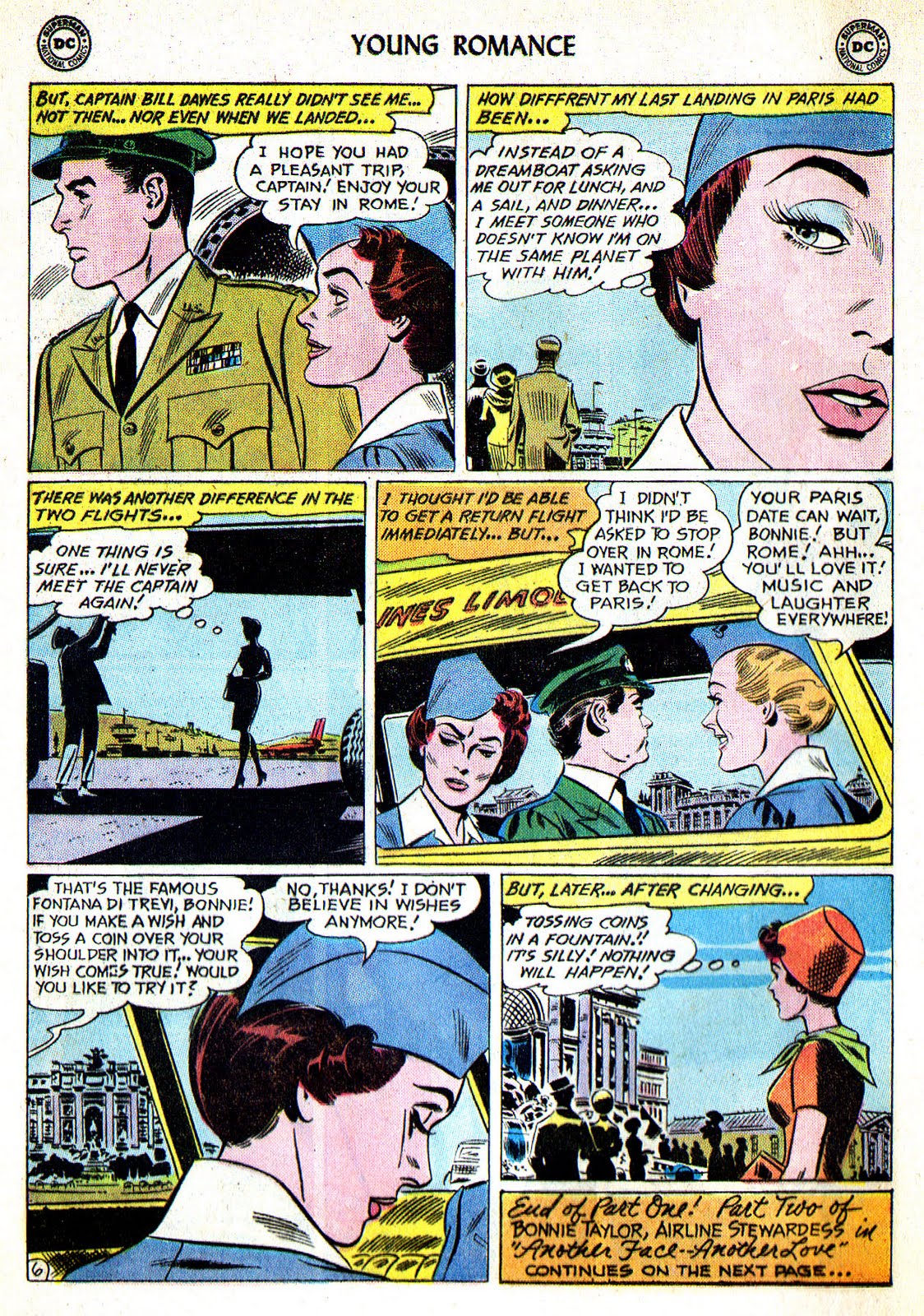
Although I have a number of these Bonnie Taylor comics in my collection, I don't have this one, the scan of which I received from another collector. The Bonnie Taylor story suggests what life is like for a woman constantly on the move in the job of an airline stewardess. Drawn by John Romita Sr. and written by Bob Kanigher, it represents the product of a high quality team working for DC at the time (mid-1960s).

'Career girl' or 'working girl' stories are fairly common in romance comics, and tended to highlight the 'career-love dilemma', most amply demonstrated by nursing romance comics, numerous examples of which can be found on this blog. In comics, nurses were exposed to an endless barrage of handsome and/or wealthy patients, as well as doctors and interns. For airline stewardesses it was passengers and pilots that provided the potential love interest, or handsome strangers in the many ports of call.

By the 1960s, Charlton Comics were the principle purveyors of career girl romance stories, with numerous nursing romance books as well as Career Girl Romances itself. Marvel adapted their previously more cartoon-like and humorous Millie the Model and Patsy Walker titles, making them more like romance titles, and DC took the bold step of orienting some of their romance books to career girls, creating ongoing features about specific characters. In Young Love it was Mary Robin, RN, also produced by Kanigher and Romita, Sr., and in Young Romance it was Bonnie Taylor in her very PanAm-ish blue uniform.

Interesting studies can be found on the traditional airline stewardess of yore. Come Fly With Us! A Global History of the Airline Hostess, Femininity in Flight: A History of Flight Attendants, and Working the Skies: The Fast-Paced, Disorienting World of the Flight Attendant are some good examples, as well as the well-researched but unfortunately canceled TV Series Pan-Am. Of note on the cover of Young Romance #127 above, the first issue to feature Bonnie Taylor, is the caption that reads, "Meet Bonnie Taylor, the lovely airline stewardess, who flies in and out of romantic adventures," suggesting that Bonnie's relationships are unlikely to be long-lasting.

Just as with the Mary Robin, RN stories, these Bonnie Taylor romances are written as a kind of diary. In Young Love the Mary Robin stories actually take the form of a diary written by Mary, but with Bonnie Taylor it is more like she is the narrator of her own tale detailing the euphoria and heartache of her fleeting encounters. So here's the story that introduced Bonnie Taylor to the eager 1960s readership of Young Romance:

   
It's interesting that Bonnie is definitely on the look out for romantic opportunities. Also interesting is the implication that Bonnie's job will drag her away from any romance she does find. In the case of the Captain, she lost out to a girl who is located in one place. The good old career-love dilemma for the working girl.