Saturday, October 4, 2014

British Romance Comics: Love Story Picture Library 752 - "Sheriffs Mustn't Cry"

Unlike the example in the previous Out Of This World post, Love Story Picture Library #752 features just one story, the one advertised on the cover - "Sheriffs Mustn't Cry." The quality of the interior artwork in this story is simply outstanding, and although I am at this point unable to identify the artist, I would guess that it is drawn by one of the Spanish artists. The story itself is not that bad either. It is an interesting genre crossover - romance and western, recalling the romantic western sub-genre of the American romance comics of the late 1940s and early 1950s. This one is a little different, though. It is set in the 1960s, and starts with a British girl selling cosmetics in the American wild west, which somehow seems to have survived relatively intact in this real backwater town that she's visiting, the ominously named Rockbottom! Aside from the odd car and other Twentieth Century electrical devices, the town looks straight out of the 1880s. The girl's name is Bernice Granger, and she's about to experience the adventure of her life! The whole story is 55 pages long, so I've tried to pick the best pages, and filled in the gaps with synopses of what's taking place. Truthfully, every page is worth savoring!


As soon as Bernice enters Rockbottom, she's commandeered by the local sheriff, who needs her assistance in going after a thief. There's just been a robbery, and it's a car and a chauffeur he needs. Bernice figures she might as well help out. They catch up with the crook, but things don't work out too well for the sheriff. He gets wounded and the crook gets away. Bernice runs to help the sheriff...


The town's new sheriff is a big hit with the locals. They've never had a lady sheriff before, and a pretty one to boot! The local newspaper editor sees an opportunity to boost his circulation, and figures he'll start by helping Bernice look the part...


While the Federal Marshall figures out a plan of action to deal with this unorthodox development, the newspaper man has gone to press with some fabricated background stories of the supposed crime-busting exploits of the new sheriff:


Meanwhile the Marshall has appointed a new sheriff himself, Jed, and sent him to Rockbottom to clear up the mess, at this point unbeknownst to Bernice, who hasn't forgotten that she initially came there to sell cosmetics:


Bernice finds herself falling head over heels for Jed. There's not much going on in Rockbottom for a young couple looking for places to hang out together, so they go off for a ride into the desert, which turns out to be a suitably romantic option:


But when Bernice finds out Jed came to replace her as the sheriff, and Jed realizes that Bernice is the illegally-appointed sheriff he's been sent to oust, a spanner is thrown into the cog-wheels of their romance. Bernice insists that she'll walk the 10 miles back to town, but Jed's macho, chauvinistic, traditionally sexist world view convinces him that forcibly grabbing Bernice and bringing her back to town is an appropriate course of action. Bernice lets him know otherwise when they get back to Rockbottom:


Press man Brad Nolan has a new idea that he thinks will help Bernice, and sell more papers. He's arranged for an election in the town for sheriff. The next day...


Then there's another unexpected turn. The festivities surrounding the election provide the perfect cover for a bank robbery. And guess who the townsfolk are expecting to apprehend the thief? Bernice accepts her responsibility, and drives off in pursuit of the robber in her classic Cadillac. She realizes that it is probably the same thief she was originally deputized to help bring to justice. It doesn't take long for her to figure that she's out of her league, but of course Jed wouldn't let her face such danger alone:


The robber steals Bernice's Cadillac and heads back to town, to the railroad yard. Jed has his man in his sights, however. With the bad guy behind bars, we can have ourselves a wedding! All ends well for our happy couple, and the newspaper has another front page story! Hopefully Bernice won't have too much trouble getting a green card and eventually American citizenship!


Amazingly, that was all based on a true story! Well, it could happen, couldn't it!? So, any ideas on who the artist of this little masterpiece was?

Friday, October 3, 2014

British Romance Comics: Love Story Picture Library 1336 - "Tell Me Why"

While visiting England earlier this year I was lucky enough to purchase a few of the digest-size British romance comics. The ten I found were from the 1960s and early 70s, and most of them belonged to the Love Story Picture Library series published by Fleetway. What was great about these finds was that some of them contained some very nice artwork that looked like it was by Spanish artists. Here's one. Love Story Picture Library # 1336 has, unlike many of these comics, one long story and a shorter story at the end (usually there's just one longer story filling the book). The total page count is 68 pages, starting at the outside front cover, so stories typically start on page 3. "Tell Me Why" is a 9-page short story at the end of the book, and as you can see it is not the cover story for this issue. This issue is from 1976, but it says inside that it was originally published in 1970, and I'd guess it probably had a different cover then. Eight new issues were published by Fleetway on the first Monday of every month, according to an ad inside. When I was a kid and buying comics in the 1960s, my main go-to was Aladins Book Shop up the top of Hornsey Road in Islington in London. It was run by Shirley and her husband Alan, and I remember that they had a huge selection of these romance books along with all the other second-hand comics, pulps, and paperbacks. Of course, at the time I was buying The Flash and Mystery in Space, but those rows and rows of British romance comics are far harder to find nowadays than their more well-known American counterparts, and contain some surprising gems. Anyway, here's the 9-page story in its entirety. Any guesses on the artist? It's fairly roughly hewn, but it looks kind of familiar!


Look out for another example in my next post - it's a beauty!

Monday, May 19, 2014

Diversity in Comics: The Little Rascals


The Little Rascals have a history that stretched from the earliest Hal Roach Our Gang short movies made in 1922, through the last of those shot in 1944, and through the 1950s and beyond with the series adapted for television and re-titled The Little Rascals. Dell Comics adapted the original movies with their 1940s Our Gang series of comic books, which included highly sought after renderings of popular cartoons at the time - Tom and Jerry, Benny the Burro, etc. - by such celebrated artists as Carl Barks and Walt Kelly. In the mid-1950s Dell produced the comic book version of The Little Rascals, that ran into the early 1960s. The importance of these Dell comics, and the movies they represent, is the fact that the Rascals are an integrated group of neighborhood kids, presented in popular media during the segregated phase of American society. And The Rascals are not without controversy. Some accused them of containing stereotyping of minorities, and television versions were later edited and scenes cut to remove offending material. It is difficult to say whether or not there was actual racist intent, due to the unfortunate norms of the time when the films were made. The fact that the cast included African American children on an equal footing with their white peers was a positive move. Did any racist elements carry over into the comics - again, difficult to say. Take a look at these two stories from The Little Rascals #1137 (Apr-May 1960) and see if you think Farina and Buckwheat are respectfully portrayed or not.


The Little Rascals series is post-Code, so there is far less likelihood that any demeaning stereotyping of minorities would be present. The original Our Gang series has been reprinted in a very nice four-volume set by Fantagraphics Books - as I was not so interested in the funny animal content of the original comics I saved myself a bundle by buying the reprint books, which only contain the Our Gang stories.

Monday, May 12, 2014

On the Trail of Fumetti

On a recent visit to Venice, one of the things I investigated was the availability of fumetti (comics). In the USA we can usually no longer find comics on newsstands, but that's not the case in Italy. There are actual newsstands dotted all over the place in Venice. They sell all sorts of stuff, some leaning more heavily towards trinkets and souvenirs than others, but quite a few (not all) carry a small selection of Italian comics.


At this one (above) on the Grand Canal, opposite the Ferrovia (railway station), comics weren't much in evidence, but there were a couple of Lanciostory and Skorpio issues tucked in among all the magazines - if you were wanting comics you would find them.


This newsstand (below) on a back street canal did have a little shelf full of comics, but it was round the side, where the steps over the bridge are in the picture.


The best place I found for new comics, though, was the newsagents at the railway station (Ferrovia). No shortage of sequential art here!


In among this wide assortment of fumetti you can see the March 2014 issue of Indistruttibile Hulk, along with more Italian fare, like Tex, the classic spaghetti western, as well as the latest issues of Lanciostory and Skorpio. The latter looked a good deal to me, packaged as it was with a free issue dedicated to the character Dago, all for less than 3 Euros. My only disappointment was that there just don't seem to be any romance titles. Back at the hotel I eagerly unpacked my Skorpio and savored the artwork - my Italian is too abysmal for me to actually read the comic without putting it all into Google Translate!


For back issues, I came across a second hand bookstore, located on the Calle dell'Olio, No 2423. You don't see anything but books and bric-a-brac when you arrive there, but just ask the owner (the guy in the striped sweater) and he'll produce a few piles of comics for you to sort through. I looked at Lanciostory, Skorpio, and Tex, and bought a couple of Tex for 1 Euro each and two Skorpio for 50 cents each. Not bad.


A closer look at the March 20th 2014 edition of Skorpio (it's weekly!!!) that I bought in the train station reveals that it contains no less than 118 pages not counting the covers, and most of those pages are comics (very few ads, and then only ads for comics). On top of this there's a 12 page Dago insert, plus the bonus 98-page black and white Dago comic! The pages of Skorpio are smooth, reasonably good quality paper. Part of the comic is in color, the rest black and white. There are 10 different ongoing series in the one comic, representing a wide variety of genres.


Inside, the first story is Amanda (featured on the cover above), written by Robin Wood and drawn by Alfredo Falugi. I learned elsewhere that this is an Argentinian comic, and that it has been going since 1995! Also from what I read elsewhere, the story is told from a female perspective. It's Good Girl Art (GGA), and reminds me a bit of Image's Danger Girl without so many guns.


There are a number of historical stories in this issue of Skorpio, with Dago by Robin Wood being one of those - looks like a 19th Century tale of love and war, with nice artwork reminiscent in places of the great Joe Kubert.


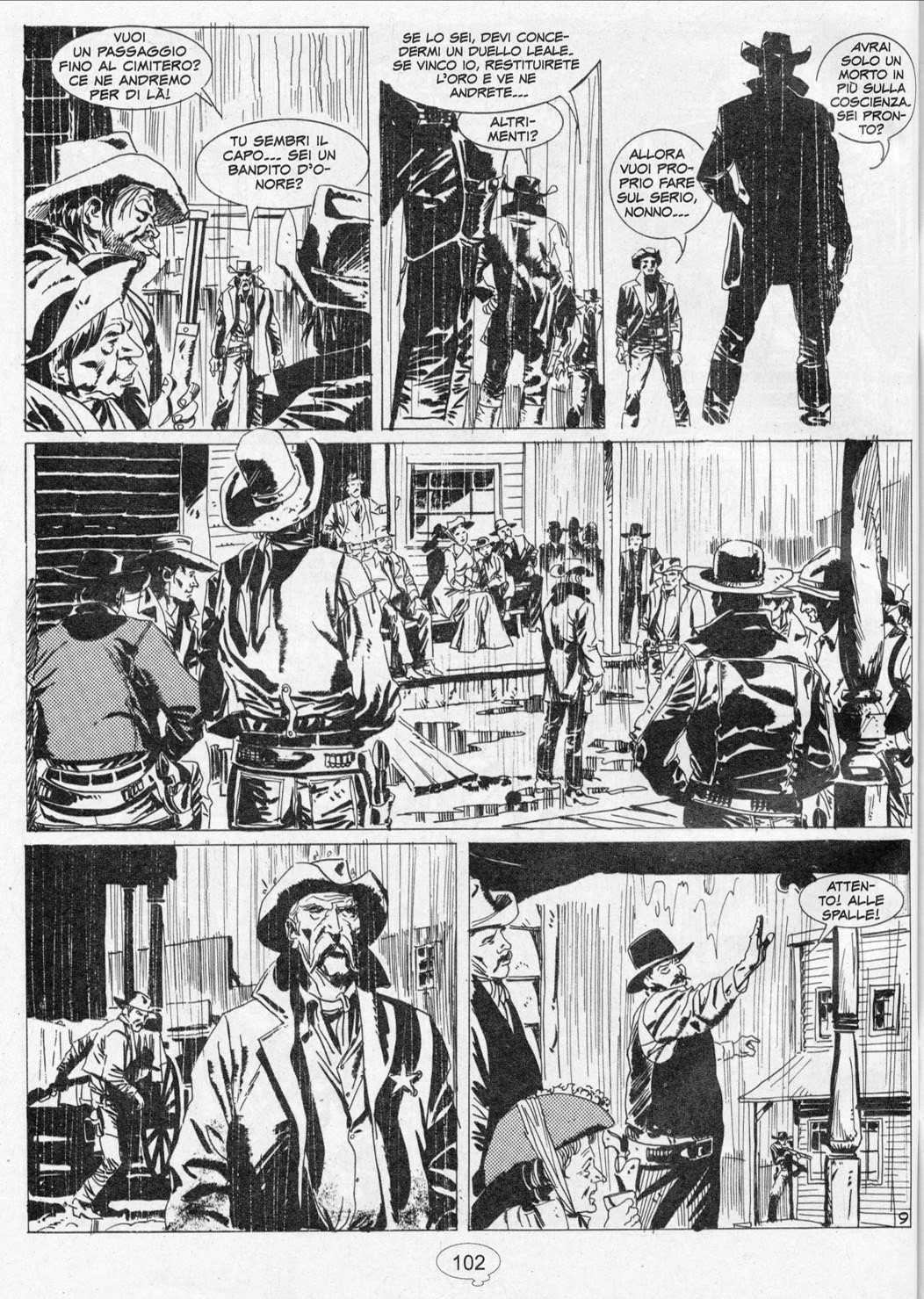
There's a police strip featuring football (soccer), a sci-fi, and one about Brooklyn firefighters. And there's a couple of good old Spaghetti Westerns! Il Grande Freddo is written by Andrea Mantelli and Paolo Ongaro, and drawn by Ongaro - very atmospheric:


Another Western, Blueberry, is one I saw complete books of at the train station. Nice color comic by Francois Corteggiani and Michel Blanc-Dumont:


These comics are in many ways very different from what we have in the USA. Multi-genre in one book. Mixture of b&w and color. Lots of pages. Cheap! Skorpio is definitely aimed at an adult audience. Clearly the Italians still like reading westerns whereas in the States that's a thing of the past. Italian comics seem to have more global content. If only I could read Italian!