Monday, May 12, 2014

On the Trail of Fumetti

On a recent visit to Venice, one of the things I investigated was the availability of fumetti (comics). In the USA we can usually no longer find comics on newsstands, but that's not the case in Italy. There are actual newsstands dotted all over the place in Venice. They sell all sorts of stuff, some leaning more heavily towards trinkets and souvenirs than others, but quite a few (not all) carry a small selection of Italian comics.


At this one (above) on the Grand Canal, opposite the Ferrovia (railway station), comics weren't much in evidence, but there were a couple of Lanciostory and Skorpio issues tucked in among all the magazines - if you were wanting comics you would find them.


This newsstand (below) on a back street canal did have a little shelf full of comics, but it was round the side, where the steps over the bridge are in the picture.


The best place I found for new comics, though, was the newsagents at the railway station (Ferrovia). No shortage of sequential art here!


In among this wide assortment of fumetti you can see the March 2014 issue of Indistruttibile Hulk, along with more Italian fare, like Tex, the classic spaghetti western, as well as the latest issues of Lanciostory and Skorpio. The latter looked a good deal to me, packaged as it was with a free issue dedicated to the character Dago, all for less than 3 Euros. My only disappointment was that there just don't seem to be any romance titles. Back at the hotel I eagerly unpacked my Skorpio and savored the artwork - my Italian is too abysmal for me to actually read the comic without putting it all into Google Translate!


For back issues, I came across a second hand bookstore, located on the Calle dell'Olio, No 2423. You don't see anything but books and bric-a-brac when you arrive there, but just ask the owner (the guy in the striped sweater) and he'll produce a few piles of comics for you to sort through. I looked at Lanciostory, Skorpio, and Tex, and bought a couple of Tex for 1 Euro each and two Skorpio for 50 cents each. Not bad.


A closer look at the March 20th 2014 edition of Skorpio (it's weekly!!!) that I bought in the train station reveals that it contains no less than 118 pages not counting the covers, and most of those pages are comics (very few ads, and then only ads for comics). On top of this there's a 12 page Dago insert, plus the bonus 98-page black and white Dago comic! The pages of Skorpio are smooth, reasonably good quality paper. Part of the comic is in color, the rest black and white. There are 10 different ongoing series in the one comic, representing a wide variety of genres.


Inside, the first story is Amanda (featured on the cover above), written by Robin Wood and drawn by Alfredo Falugi. I learned elsewhere that this is an Argentinian comic, and that it has been going since 1995! Also from what I read elsewhere, the story is told from a female perspective. It's Good Girl Art (GGA), and reminds me a bit of Image's Danger Girl without so many guns.


There are a number of historical stories in this issue of Skorpio, with Dago by Robin Wood being one of those - looks like a 19th Century tale of love and war, with nice artwork reminiscent in places of the great Joe Kubert.


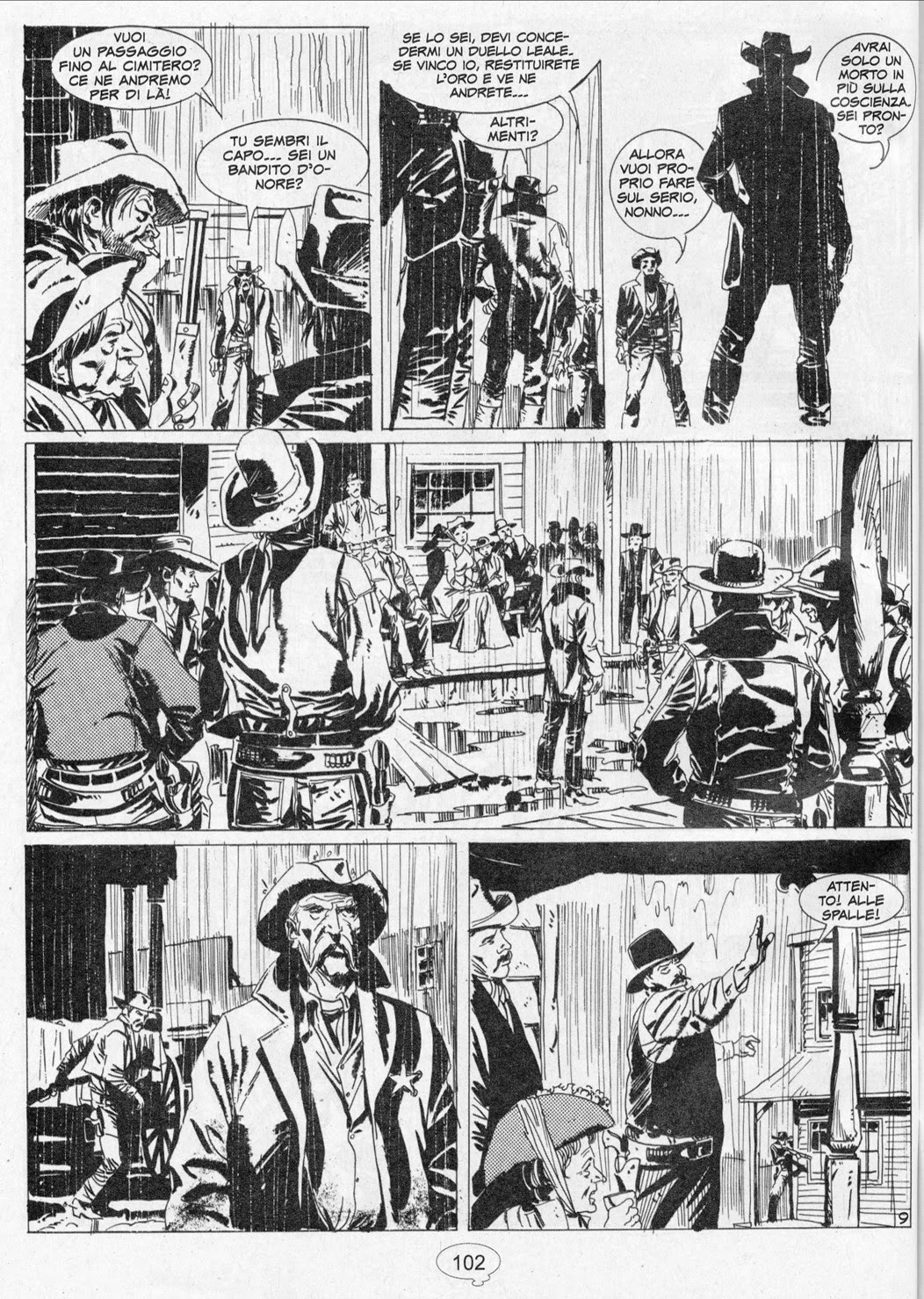
There's a police strip featuring football (soccer), a sci-fi, and one about Brooklyn firefighters. And there's a couple of good old Spaghetti Westerns! Il Grande Freddo is written by Andrea Mantelli and Paolo Ongaro, and drawn by Ongaro - very atmospheric:



Another Western, Blueberry, is one I saw complete books of at the train station. Nice color comic by Francois Corteggiani and Michel Blanc-Dumont:


These comics are in many ways very different from what we have in the USA. Multi-genre in one book. Mixture of b&w and color. Lots of pages. Cheap! Skorpio is definitely aimed at an adult audience. Clearly the Italians still like reading westerns whereas in the States that's a thing of the past. Italian comics seem to have more global content. If only I could read Italian!

Wednesday, April 2, 2014

Jorge Badia Romero? Charlton's Time for Love 47: "Dream Come True"


According to the Grand Comics Database, the cover of the last issue of Charlton's Time for Love, # 47, and the interior story, Dream Come True, are by Jorge Badia Romero. I'm not an expert on the Spanish artists who worked on American and European romance comics from the period (1960s through 70s), but to me I see some elements of this piece that look like either Jose Gonzalez or Enrique Badia Romero. In fact I'm led to suspect that maybe more than one artist contributed to this story. What do you think?


Derek cuts a formal profile but he's also a bit of a smooth talker, albeit a genuine one.


Kathy is apparently easily swayed by a flashy lifestyle and a sprinkling of cash!


Quite good story. I like the resolution to the dilemma. Very nice artwork - intriguing, tantalizing. Jorge Badia Romero - new discovery for me!

Wednesday, March 26, 2014

British Girls' Comics: Diana Annual 1975 and 1974 - Fabulous Four by Enrique Badia Romero

With every little bit I learn about the Spanish artists who worked for British and American comics in the 1960s and 70s, the more I realize that I don't know. These artists were/are simultaneously often very expert and accomplished in terms of the work they produced, but remain relatively poorly known, except for one or two. Enrique Badia Romero is one of the better known, but understanding even his work is complicated by the fact that he had a brother who was also a comic artist with a very similar style. Out Of This World has previously featured examples of Romero's work on British girls' annuals, and here's a couple more. First is the Fabulous Four story from the 1975 Diana Annual. When I try to define what it is that makes it Romero, I gravitate to the bushy eyelashes, the wisps of out-of-control hair, the liberally-applied eye shadow, and the pouting lips. But as those of you who like the work of Spanish artists will know, Romero isn't the only one whose women are rendered in this fashion. We're sometimes down to very subtle differences in the 'Spanish' or 'Catalan' style. And with these artists often not signing their work, the problem can get complex. So I have to say that I think, I'm pretty sure, this is Enrique Badia Romero, but I can't be 100% sure unless David Roach agrees! One thing is for sure, 'Spanish' artists deserve wider recognition for the work they did in Britain and the USA.


Now here's the 1974 Diana Annual Fabulous Four story. Was it the first? I don't know. The art looks similar to the 1975 story, but different at the same time. Does it represent an earlier phase in the evolution of the same artist? Is it more restrained, deliberately, because the artist was attempting to test the water? The characters certainly look younger. Is it by Romero's brother? Different inker? What do you think?


I don't have any more Diana annuals, so I think that's the last we'll be looking at the Fabulous Four here on Out Of This World. But watch out for more work by Spanish artists in upcoming posts.

Saturday, February 8, 2014

Enrique Badia Romero - Axa, from Il Mago #96, March 1980

Enrique Badia Romero is best known for his newspaper strips, especially Modesty Blaise. His work on Axa probably comes in second in terms of recognition, but as you can see from the examples below, it's superb. These are three pages from a section of newspaper strip reprints in an Italian fumetto called Il Mago from around about 1980. There are (or should I say were) reprint collections available in English and some are still obtainable at non-astronomical prices on Amazon, but I guess they are all way out of print. Time for Fantagraphics to put together a new edition?


I don't know about you but I want to know what happens next! The sword and sorcery genre, which Axa seems to be part of, is one of a number of Bronze Age innovations or revivals that mark a shift in comic reader tastes happening at the end of the 1960s and into the 70s. That change doesn't seem to be coincidental, given the goings on in society - Civil Rights, Feminism, anti-war movements, and general discontent with what had been the status quo. The beginnings of the Bronze Age in comics appears to be a period worthy of further in-depth study, for both its creative achievements as well as what it might tell us about our society at that important time. As I have been focusing over the last few years on desegregation in American comics, that much has become increasingly apparent the more I study.