Thursday, March 10, 2011

Diversity in Comics: Tiny and Little Audrey


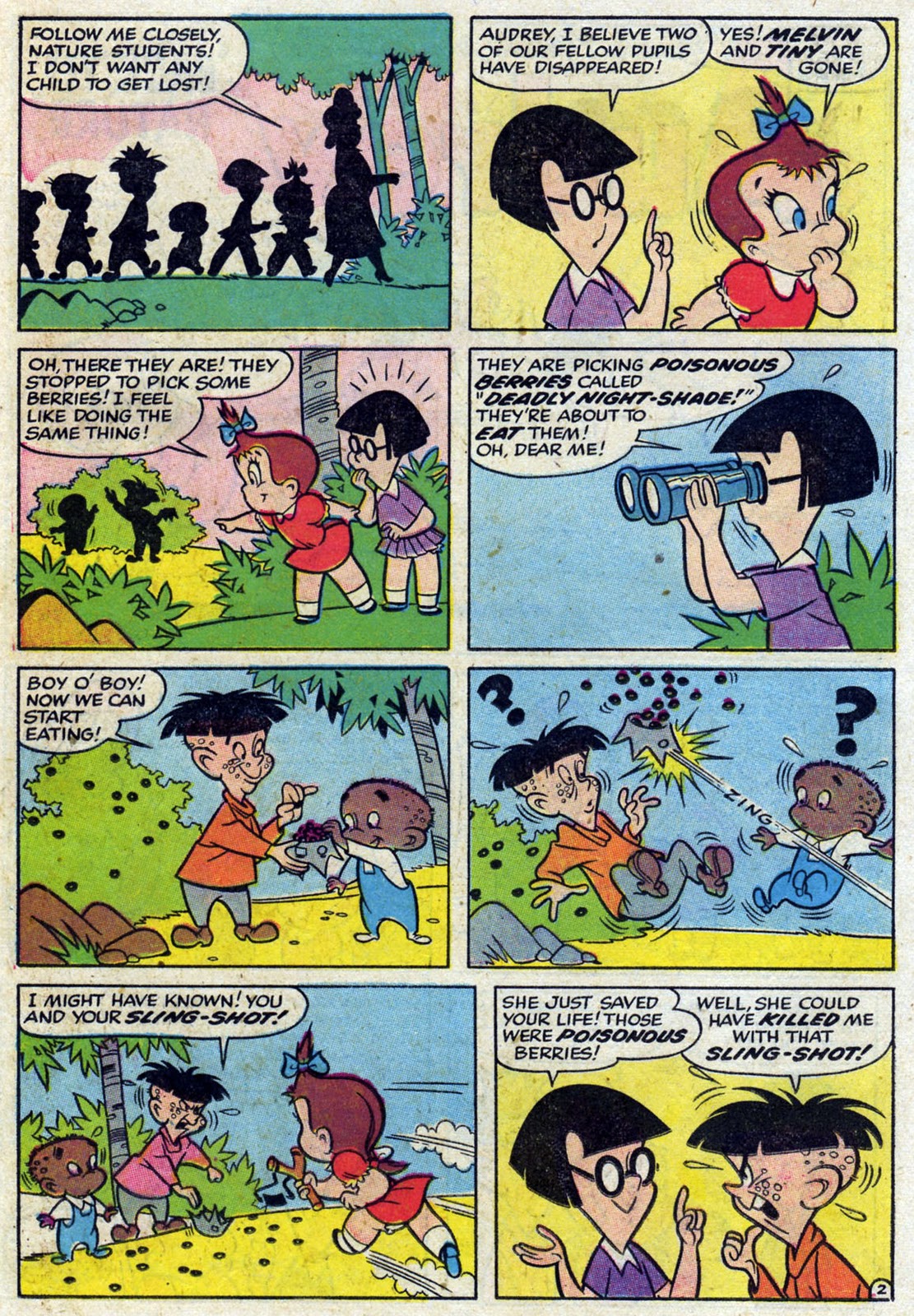
Little Audrey was originally published by St. John but later became a Harvey Comics title. In the mid-1950s, totally against the norm for mainstream comic books, it included an African American character, Tiny, who wasn't some bizarre stereotype, but was just a normal kid like the other characters in the stories. He hung out with Audrey and Melvin, and participated in the group's adventures. He even had his own feature. In this first Audrey story, from Little Audrey 42 (June 1955), Tiny is one of the main protagonists. There's no racial disharmony, and race isn't mentioned - it isn't presented as an issue. This is just a bunch of kids who are friends and do stuff together.


This next Audrey story, again from Little Audrey 42, also features Tiny, who is as much in difficulty in dealing with the intellectual new girl as are the others.



Finally, here's a solo Tiny story, from Playful Little Audrey 2 (August 1957). The cover is typical of Harvey kids' comics covers from the 50s and 60s.We learn a little about Tiny's background from this one. He's got a cute mom. The family lives in a nice house, and Tiny is well-dressed. This looks like a middle class part of town. They have a nice yard as well. So Harvey are not trying to lay a whole ghetto image on Tiny. There's no blaxploitation here. Tiny's a middle class kid from a well-resourced home.


If you're interested in reading another Tiny story, there's one from Playful Little Audrey 4 over on Mykal Banta's blog, The Big Blog of Kids' Comics. You'll have to scroll down past the first two Audrey stories (or read them first on your way down the page). Anyway - interesting stuff! Smack bang in the middle of the still segregated 50s, when there were, with very few exceptions, no African American characters in mainstream fictional comics, we've got a character appearing fairly regularly, even getting his own strip. How revolutionary is that!!! Many thanks to Green Giant for the Little Audrey 42 scans, and SOTE for the Tiny story.

Wednesday, March 9, 2011

Diversity in Comics: African Americans in the Funny Books


As African American characters gradually appeared in mainstream comic books in the latter half of the 1960s, the publishers of funny books began to illustrate greater diversity in their fictional populations. I do seem to remember an African American character, Tiny, appearing in Little Audrey comics around this time, but I'm unable to find an example. Instead here's the second issue of Josie and the Pussycats (#46, art by Dan DeCarlo), which I think is the first Archie cover featuring an African American character, from Feb 1970. Valerie Smith first appeared in the previous issue (Dec 1969), joining Josie's new band, and is now on the cover of issue 46. In this particular story she is not the main focus, but is there throughout. Here's a couple of pages that are typical of her level of involvement:


And again, later on, she's obviously an equal member of the cast of characters in this comic. In this story she's as much in evidence as is Josie.


Almost like a romance comic, there's a double page fashion feature, again including Valerie:


There's no big fuss made about race with Valerie - she's simply included in the new line up as the book changed direction (and the characters became hugely successful!). Also introduced in Archie comics was Chuck Clayton, an African American male character who first appeared in August 1971 in Jughead 195 and Life With Archie 112. His first cover appearances were on Life With Archie 115 and Archie Annual 23 (see images below from the Grand Comics Database).


Below are a few more images I borrowed from the Grand Comics Database that illustrate some other 1970s funny/teen humor comics that featured African American characters. The first issues of Harlem Globetrotters (Apr 1972 - Jan 1975) and Fat Albert and the Cosby Kids (March 1974 - Feb 1979), published by Gold Key are shown here - these two series are related to TV cartoon shows.


Fast Willie Jackson was a short-lived series that had a majority African American cast. Published by Fitzgerald, this Archie-style teen humor book ran from Oct 76 - Sept 77. For comparison, here's an Archie cover from July 1977 with a similar dance scene to that on Fast Willie Jackson 1 - not much change at Archie since Valerie Smith debuted in 1970.


If anyone knows any other information on the early appearances of African American characters in funny comics (not disrespectful stereotypes) it would be greatly appreciated if you could post it in a comment here. The earliest I have heard of is 'Tiny', friend of Little Audrey in the Harvey Comics' series of that name, in the mid-1950s! What I'm also interested in is any ideas for analyzing these images. Were the Archie books including token African American characters to be politically correct, or did they have a serious agenda through which they aimed to more accurately represent diversity in American society in their very American comic books?

Friday, March 4, 2011

Social History in Comics: Dr. MLK Jr.


Although victims of racial discrimination and the whole segregation debacle, the African Americans subscribing to Dr. MLK Jr.'s combined Gandhian and Christian approach to winning social and political change exhibit a remarkable level of tolerance towards their oppressors, as evidenced by this publication from the Fellowship of Reconciliation. The first part of the book recounts the history of MLK Jr.'s life and his connection with the Civil Rights Movement. It's reassuring to see that white supporters of racial equality are acknowledged.


The rest of the book gives us a fascinating glimpse, not only into King's approach to achieving change, but to the prevailing conditions that necessitated his tactics. It's uncomfortable but necessary reading, especially because it allows us to observe a baseline by which the outcomes of the Civil Rights Movement can be assessed. The discomfort comes from the unpleasant truth regarding the unjust way a whole section of American society was oppressed and discriminated against.


It's an amazing piece of primary historical evidence that documents King's philosophy, with illustrative examples, and it's especially interesting that it seemingly comes from an African American perspective, although the Fellowship of Reconciliation was not a race-based organization. It's actually a piece of propaganda from an ideological, pacifist 'war' against the tyranny of oppression - very, very American in its underlying principles, and in line with the philosophy at the fundamental core of human rights.

If you enjoyed this comic you might like to read the Golden Legacy Illustrated History of the Life of Martin Luther King Jr.

Tuesday, March 1, 2011

Nurses as Objects in Comics: Joe Yank 12 - "The Battle of the Sexes"


Joe Yank was an early 50s Standard title of a kind of war comedy genre. Private Joe Yank and Sgt. Mike McGurk are the two main characters. I just acquired this comic, but I'm using pages from the scan available in the Digital Comic Museum. In this story, "Battle of the Sexes" by Ross Andru, we have a perfect example of image discrimination coupled with sexist exploitation of the female form. You'll also note the misleading cover, which depicts a scene that is not part of the actual story. What happens is McGurk gets hospitalized, and in the ward he encounters a nurse who doesn't fit the usual comic book stereotype of the pinup. With little else to do, and with a score to settle with Joe Yank, McGurk hatches a plan to make the Private experience some serious discomfort. He exploits the plain nurse's eagerness to find a man, and her unattractive features, to carry out his scheme.


Joe Yank turns up at the hospital to visit McGurk, and his first encounter with the nursing staff feeds his expectations, based on the kind of nurse image typically promoted by the male mind indulging in fantasy. This softens Joe Yank up for McGurk's ruse, and he buys it, hook, line, and sinker.


Joe Yank goes on his date, only to find he's been had. All he can think of from the moment he  meets the man-hungry homely nurse is how to get away, and in the end he has to resort to some extreme measures.


I know it's a comedy designed most likely for male military readers, but I can't help feeling that there's something not right about the way the unattractive woman is made fun of and is also humiliated. Not all women and not all nurses look like Marilyn Monroe.


Kind of an unusual nurse tale that raises some interesting questions about attitudes towards women in the early 1950s.