This (June 1963, Our Army At War 131) is one of my favorite Sgt. Rock covers by Joe Kubert. Rock's karmic bullet-dodging ability is very much in evidence as usual, and those companions near him seem to imbibe the same characteristic. I like the way the nurse is driving, ducking, and tending to her patient simultaneously. Women are such multi-taskers! As is fairly typical with these Robert Kanigher/Joe Kubert stories, the first half of the tale sets the reader up for the main idea. The story begins with Rock wounded and being brought to the field hospital. His men then recount the circumstances that led to Rock's condition.
Rock needs a blood transfusion (one of Kanigher's favorite strategies?) and he's AB-, a rare blood type. Nobody amongst the Doc and Easy have a compatible blood type, but a wounded army nurse lying on a stretcher next to Rock does. She insists the Doc use her blood to help Rock, and the Sergeant pulls through. Rock gets separated from her before he can summon sufficient strength to speak, to thank her, and to find out her name. Once fully fit, Rock embarks upon a quest to find his nurse savior, but it isn't proving easy even for Easy.
Then Fate intervenes again. There's an enemy breakthrough and Easy are threatened by a group of Nazi tanks. To give the rest of the men time to escape, Rock and his bazooka man, Zack, slow down the tanks, but eventually are caught in the blast of a shell that explodes close by, and Zack is hurt. Rock won't leave his man to die, and hauls him off in an attempt to reach safety. It's then that he comes across the same nurse, this time in a stalled jeep carrying wounded men, and she can't get it re-started. Rock uses the bazooka to try to keep the tanks at bay. However, it's the U.S. Air Force that arrives in the nick of time to scatter the Nazis, but not before the nurse is hit and wounded. Rock gets the jeep going and races frantically to the medical station, where he's able to repay the favor granted him previously, by donating his blood to save the nurse.
With so many of the great comic book writers and artists being vets, it maybe isn't surprising that nurses appear frequently, certainly in war comics and in romance comics with war connections. And there are true stories of brave nurses close to or on the battlefield. The image of nurses provided by this story is again that of the self-sacrificing angel, refusing to seek her own safety if it meant abandoning her patients.
Friday, June 11, 2010
Wednesday, June 9, 2010
Nurses At War: Young Romance 78 - "Army Nurse"
It took me some time to get this book. These Simon and Kirby post code issues are fairly tough to find. The cover is directly related to the nurse romance story that I am interested in here, set in a Mobile Army Surgical Hospital in Korea. The art is by Argentinian artist Jo Albistur (signed).
In "Army Nurse", the nurses all love Doctor Roy, but the Doc only has eyes for one of them, and that's Joyce. He's been preparing to pop the question, and does so after a hard day's work. Joyce is over the moon to be engaged to her dream boat.
For some reason Roy keeps quiet about why he seems to always be giving Ruth Duryea assignments to work with him. Sure, he gives some plausible explanations - she's new and needs the training - but it doesn't quite all add up. Suddenly Joyce is snapped out of her jealous fog by the news that Roy's aircraft has gone down, and he's hurt. Joyce immediately volunteers to be the nurse to travel to the crash site. On the way the flak from the North Koreans almost makes her wish she'd stayed back at the camp, but she gets there to find Ruth tending to her intended. This is a bit much for her to take, and she removes her engagement ring from her finger and slips it into Roy's pocket, her dream perhaps over. Setting aside her jealousy, Joyce does the needful. Back at the M.A.S.H. Roy is operated on. However, afterward Ruth flies in and is assigned to the care of the wounded. It is then that Joyce discovers something that changes the whole picture.
Ruth has no romantic inclinations towards Roy. She's already married to the injured sergeant, secretly, because it's against regulations. Doctor Roy Nelson knew and has been covering for them. Joyce realizes what a chump she's been and fumbles in Roy's pocket to get her ring back. He's already ahead of her though, having found the ring there himself. He sees that his position, surrounded by a flock of marriageable, lovely nurses makes life difficult for Joyce, and so he prescribes the only reasonable cure - a wedding.
I like this artwork by Jo Albistur. I think I have another example of his work somewhere. He's mentioned on the Simon & Kirby Museum blog. It reminds me somewhat of Al Williamson's work. The image of nurses presented by this piece include the usual - aspiring for romantic involvement with a doctor, bitchy rivalry, they're all pretty in their nicely starched white uniforms and caps. These are nurses at war so there's bravery and willingness for self-sacrifice. Nice switch to the blue uniform for going out into the battlefield. Ruth Duryea is a redhead for the cover but blond in the story. Panel 7 on page 5 looks like it was intentionally drawn to match the cover, and is a little out of Albistur's natural style as a result (the cover looks Kirby or Simon/Kirby to me).
In "Army Nurse", the nurses all love Doctor Roy, but the Doc only has eyes for one of them, and that's Joyce. He's been preparing to pop the question, and does so after a hard day's work. Joyce is over the moon to be engaged to her dream boat.
For some reason Roy keeps quiet about why he seems to always be giving Ruth Duryea assignments to work with him. Sure, he gives some plausible explanations - she's new and needs the training - but it doesn't quite all add up. Suddenly Joyce is snapped out of her jealous fog by the news that Roy's aircraft has gone down, and he's hurt. Joyce immediately volunteers to be the nurse to travel to the crash site. On the way the flak from the North Koreans almost makes her wish she'd stayed back at the camp, but she gets there to find Ruth tending to her intended. This is a bit much for her to take, and she removes her engagement ring from her finger and slips it into Roy's pocket, her dream perhaps over. Setting aside her jealousy, Joyce does the needful. Back at the M.A.S.H. Roy is operated on. However, afterward Ruth flies in and is assigned to the care of the wounded. It is then that Joyce discovers something that changes the whole picture.
Ruth has no romantic inclinations towards Roy. She's already married to the injured sergeant, secretly, because it's against regulations. Doctor Roy Nelson knew and has been covering for them. Joyce realizes what a chump she's been and fumbles in Roy's pocket to get her ring back. He's already ahead of her though, having found the ring there himself. He sees that his position, surrounded by a flock of marriageable, lovely nurses makes life difficult for Joyce, and so he prescribes the only reasonable cure - a wedding.
I like this artwork by Jo Albistur. I think I have another example of his work somewhere. He's mentioned on the Simon & Kirby Museum blog. It reminds me somewhat of Al Williamson's work. The image of nurses presented by this piece include the usual - aspiring for romantic involvement with a doctor, bitchy rivalry, they're all pretty in their nicely starched white uniforms and caps. These are nurses at war so there's bravery and willingness for self-sacrifice. Nice switch to the blue uniform for going out into the battlefield. Ruth Duryea is a redhead for the cover but blond in the story. Panel 7 on page 5 looks like it was intentionally drawn to match the cover, and is a little out of Albistur's natural style as a result (the cover looks Kirby or Simon/Kirby to me).
Cute Girlie Stuff: Paper Dolls and Katy Keene
[Note: if you are interested in this post, then you may also want to look at more recent Out of This World posts that features more Katy Keene paper dolls and Patsy Walker and Millie the Model paper dolls].
Earlier this year I found Linda's 'The Paper Collector' blog while searching for information on Torchy Brown, a newspaper comic strip drawn by the first African American female comic artist, Jackie Ormes. Linda had a feature about Torchy Brown on one of her other blogs, in which she had posted scans of a Torchy Brown strip and the accompanying Torchy Brown paper dolls. Kind of out of the corner of my eye I noticed that paper dolls have a very enthusiastic following, just like comic books. And here was an instance where the two disciplines meet - comix scholars and paper doll students. I would be interested to know just when this association between the two began. The Torchy Brown strip featured in Linda's post is from the early 50s. I looked through comics I suspected might have paper dolls. Sure enough I came up with some (well I knew I'd seen them in there before). Some examples:
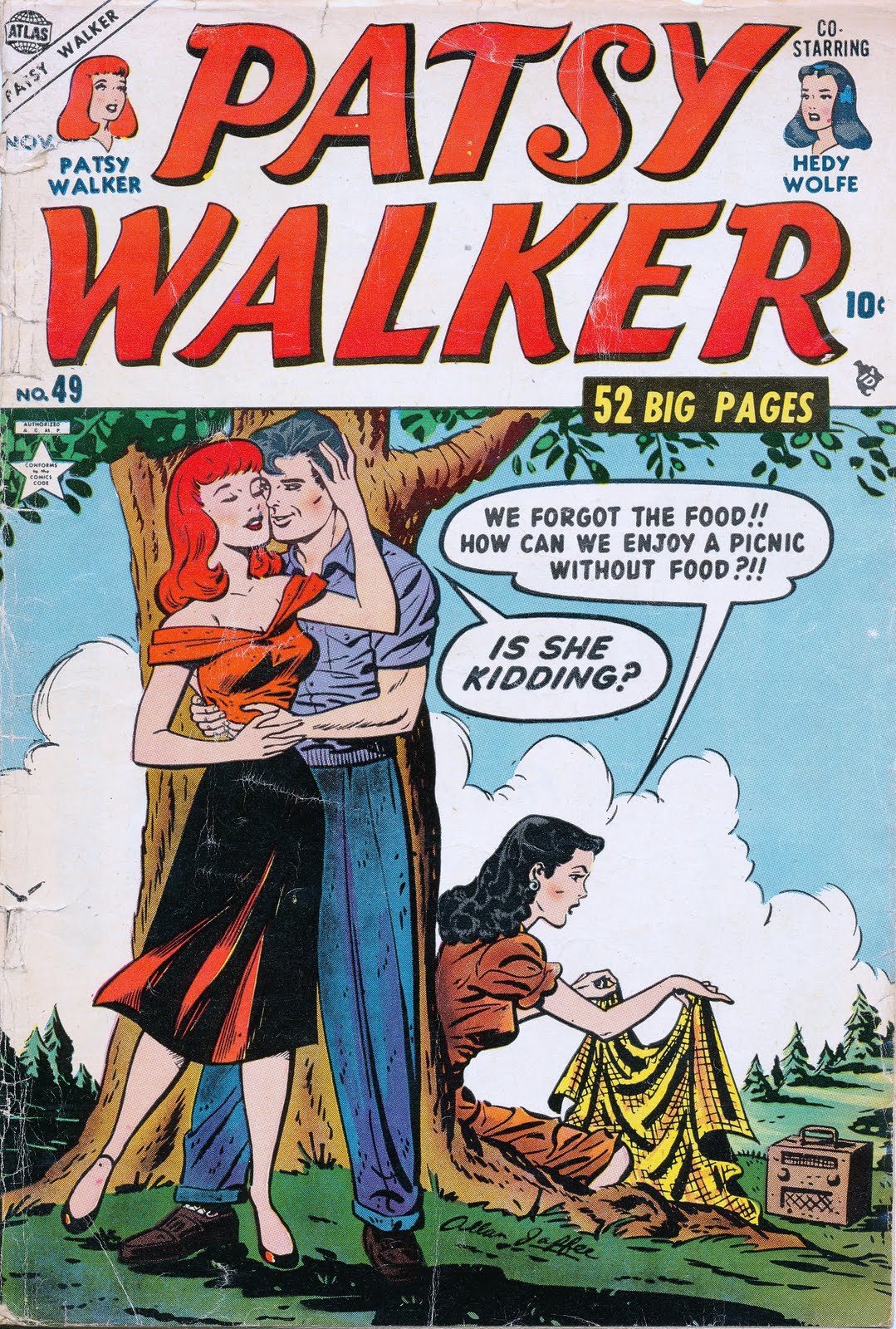
This is Patsy Walker 49 published by Atlas in November 1953. It has just one page with a paper doll. It says it's #16 (in a series?), and the clothing design appears to have been sent in by a reader.
Here's Patsy Walker in Miss America 86 from September 1957, again published by Atlas. The cover is one of the many from this period that depict 1950s suburban and small town life by the superb Al Hartley. Only one page with a paper doll on again.
Archie's Pals 'n' Gals 21 from Summer 1962 has a couple of pages with Veronica paper dolls. Are these drawn by Jon D'Agostino?
Patsy Walker 104 (Marvel, December 1962) has another great Al Hartley cover plus no less than three pages of paper dolls. Al seems to have left off the tabs from the outfits, either by design or forgetfulness - which, we'll never know. If I ever get to interview Stan Lee I have more pressing issues to ask him about, but more out of idle curiosity I might just ask him (in my dreams!). So paper doll collectors, where there's Patsy there's dolls, at least from the mid-50s through the mid-60s, as we shall see.
This one definitely is drawn by Jon D'Agostino. It's Charlton's My Little Margie 49 from September 1963, and it has just one page with a Margie cut-out doll. Note the continuing theme of reader-generated designs.
Patsy Walker 119 (Feb 1965) and Patsy & Hedy 99 (Apr 1965) each have two pages of paper dolls, but it seems that Al Hartley's tab-less outfits have persisted even though he's no longer the artist. But where does Katy Keene come into all this? Well I'm pretty sure paper dolls can be found in Katy Keene comics but I don't have proof. This is because every time I try to obtain a Katy Keene comic on eBay I get outbid or the Buy It Now price is more than I'm willing to pay. Katy Keene has a following. Katy Keene is popular. Katy Keene was published by Archie and drawn in irresistible fashion by Bill Woggon. It turns out though that, quite by accident, I do have one example in my collection. My copy of Laugh 114 (September 1960) has a 6 page Katy Keene story. So here it is - not too many panels with Katy in but enough to get a taste of Bill Woggon's unique artwork. Katy is a doe-eyed, dark-haired, perfect beauty drawn in a way that is confusingly pleasing to the eye, hence Woggon's popularity and the cost of Katy Keene books. This is, I would say, a kind of good girl art, a topic I would like to explore on another occasion, as a I feel a clear definition of the term is long overdue.
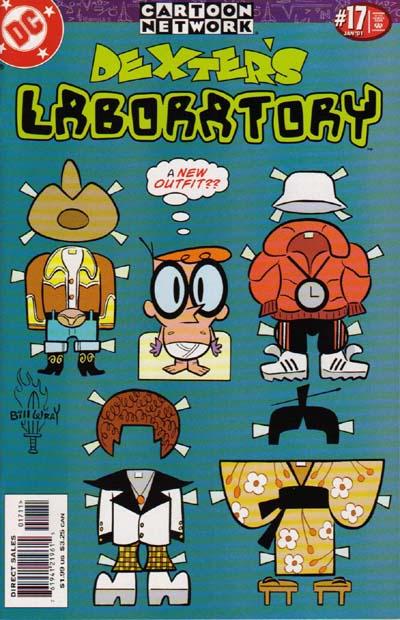
Even though there are no paper dolls with this one, the story itself uses outfits designed and sent in by readers, as do the other books sampled in this post. Thus ends my first real excursion into the world of paper dolls through the portal of comics, with a diversion into Katy Keene, as a special thanks to Linda for giving me permission previously to use her Torchy Brown scan for my presentation and article. It's also mine and my wife Sheila's 27th wedding anniversary today, and she's often told me how she used to play endlessly with paper dolls when she was a girl in the 50s. So it's nice for me to contact something from my spouse's childhood experience. Just to finish, the most recent comic that I'm aware of with, in this case, spoof paper dolls is Dexter's Laboratory 17 published by DC in January 2001. I just sold my son's collection of these and forgot to scan the cover of this one before it went, but there's a complete cover gallery in the GCD, in which you can view the one I'm referring to.
Earlier this year I found Linda's 'The Paper Collector' blog while searching for information on Torchy Brown, a newspaper comic strip drawn by the first African American female comic artist, Jackie Ormes. Linda had a feature about Torchy Brown on one of her other blogs, in which she had posted scans of a Torchy Brown strip and the accompanying Torchy Brown paper dolls. Kind of out of the corner of my eye I noticed that paper dolls have a very enthusiastic following, just like comic books. And here was an instance where the two disciplines meet - comix scholars and paper doll students. I would be interested to know just when this association between the two began. The Torchy Brown strip featured in Linda's post is from the early 50s. I looked through comics I suspected might have paper dolls. Sure enough I came up with some (well I knew I'd seen them in there before). Some examples:
This is Patsy Walker 49 published by Atlas in November 1953. It has just one page with a paper doll. It says it's #16 (in a series?), and the clothing design appears to have been sent in by a reader.
Here's Patsy Walker in Miss America 86 from September 1957, again published by Atlas. The cover is one of the many from this period that depict 1950s suburban and small town life by the superb Al Hartley. Only one page with a paper doll on again.
Archie's Pals 'n' Gals 21 from Summer 1962 has a couple of pages with Veronica paper dolls. Are these drawn by Jon D'Agostino?
Patsy Walker 104 (Marvel, December 1962) has another great Al Hartley cover plus no less than three pages of paper dolls. Al seems to have left off the tabs from the outfits, either by design or forgetfulness - which, we'll never know. If I ever get to interview Stan Lee I have more pressing issues to ask him about, but more out of idle curiosity I might just ask him (in my dreams!). So paper doll collectors, where there's Patsy there's dolls, at least from the mid-50s through the mid-60s, as we shall see.
This one definitely is drawn by Jon D'Agostino. It's Charlton's My Little Margie 49 from September 1963, and it has just one page with a Margie cut-out doll. Note the continuing theme of reader-generated designs.
Patsy Walker 119 (Feb 1965) and Patsy & Hedy 99 (Apr 1965) each have two pages of paper dolls, but it seems that Al Hartley's tab-less outfits have persisted even though he's no longer the artist. But where does Katy Keene come into all this? Well I'm pretty sure paper dolls can be found in Katy Keene comics but I don't have proof. This is because every time I try to obtain a Katy Keene comic on eBay I get outbid or the Buy It Now price is more than I'm willing to pay. Katy Keene has a following. Katy Keene is popular. Katy Keene was published by Archie and drawn in irresistible fashion by Bill Woggon. It turns out though that, quite by accident, I do have one example in my collection. My copy of Laugh 114 (September 1960) has a 6 page Katy Keene story. So here it is - not too many panels with Katy in but enough to get a taste of Bill Woggon's unique artwork. Katy is a doe-eyed, dark-haired, perfect beauty drawn in a way that is confusingly pleasing to the eye, hence Woggon's popularity and the cost of Katy Keene books. This is, I would say, a kind of good girl art, a topic I would like to explore on another occasion, as a I feel a clear definition of the term is long overdue.
Even though there are no paper dolls with this one, the story itself uses outfits designed and sent in by readers, as do the other books sampled in this post. Thus ends my first real excursion into the world of paper dolls through the portal of comics, with a diversion into Katy Keene, as a special thanks to Linda for giving me permission previously to use her Torchy Brown scan for my presentation and article. It's also mine and my wife Sheila's 27th wedding anniversary today, and she's often told me how she used to play endlessly with paper dolls when she was a girl in the 50s. So it's nice for me to contact something from my spouse's childhood experience. Just to finish, the most recent comic that I'm aware of with, in this case, spoof paper dolls is Dexter's Laboratory 17 published by DC in January 2001. I just sold my son's collection of these and forgot to scan the cover of this one before it went, but there's a complete cover gallery in the GCD, in which you can view the one I'm referring to.
Labels:
Al Hartley,
Archie,
Atlas,
Bill Woggon,
Charlton Comics,
DC,
Dexter's Laboratory,
Jon D'Agostino,
Katy Keene,
Marvel,
Miss America,
My Little Margie,
paper dolls,
Patsy and Hedy,
Patsy Walker
Subscribe to:
Posts (Atom)