Showing posts with label John Romita Sr.. Show all posts

Saturday, December 28, 2013

The Friendly Skies: Young Romance 127 - "Another Face, Another Love"

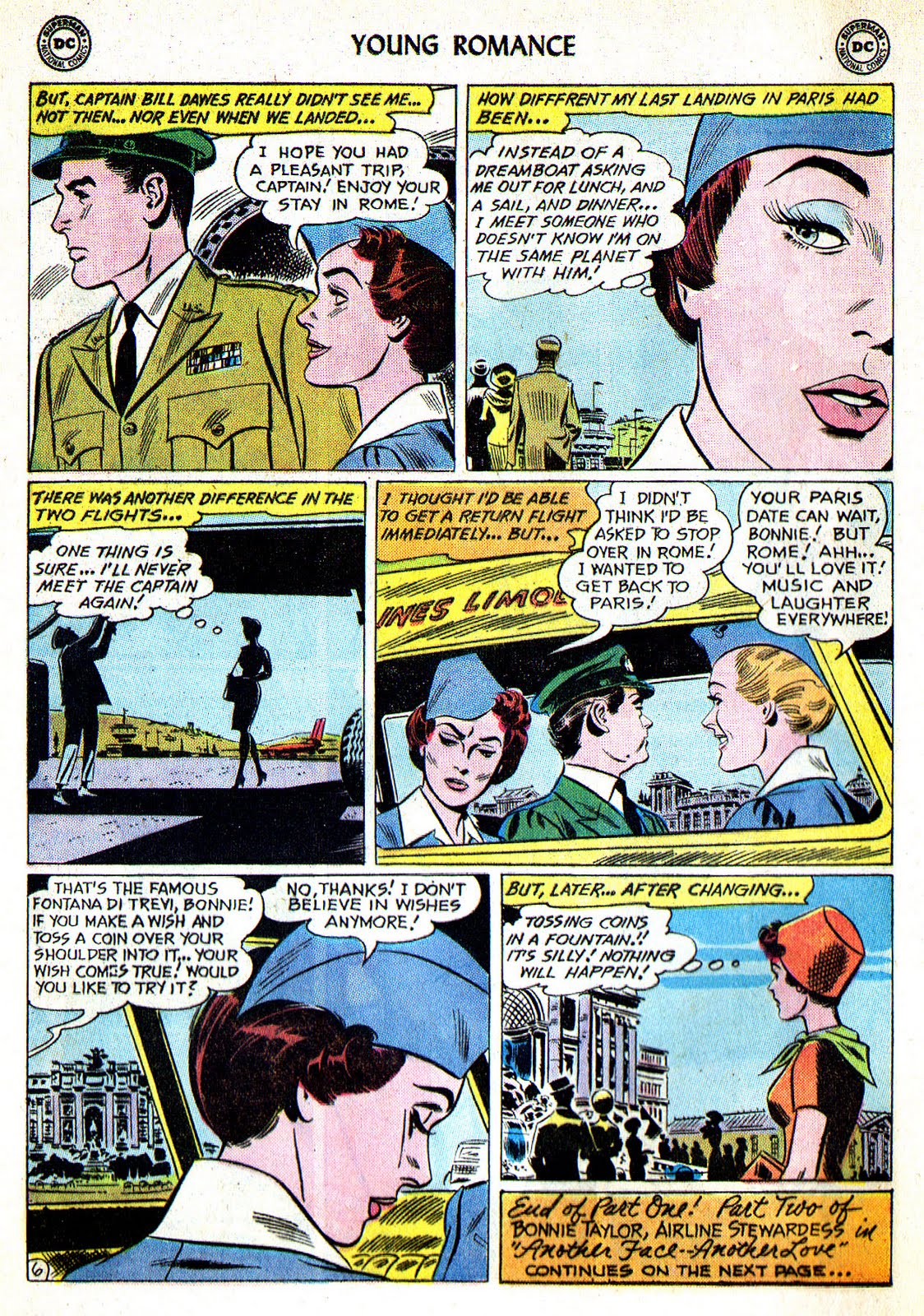
Although I have a number of these Bonnie Taylor comics in my collection, I don't have this one, the scan of which I received from another collector. The Bonnie Taylor story suggests what life is like for a woman constantly on the move in the job of an airline stewardess. Drawn by John Romita Sr. and written by Bob Kanigher, it represents the product of a high quality team working for DC at the time (mid-1960s).

'Career girl' or 'working girl' stories are fairly common in romance comics, and tended to highlight the 'career-love dilemma', most amply demonstrated by nursing romance comics, numerous examples of which can be found on this blog. In comics, nurses were exposed to an endless barrage of handsome and/or wealthy patients, as well as doctors and interns. For airline stewardesses it was passengers and pilots that provided the potential love interest, or handsome strangers in the many ports of call.

By the 1960s, Charlton Comics were the principle purveyors of career girl romance stories, with numerous nursing romance books as well as Career Girl Romances itself. Marvel adapted their previously more cartoon-like and humorous Millie the Model and Patsy Walker titles, making them more like romance titles, and DC took the bold step of orienting some of their romance books to career girls, creating ongoing features about specific characters. In Young Love it was Mary Robin, RN, also produced by Kanigher and Romita, Sr., and in Young Romance it was Bonnie Taylor in her very PanAm-ish blue uniform.

Interesting studies can be found on the traditional airline stewardess of yore. Come Fly With Us! A Global History of the Airline Hostess, Femininity in Flight: A History of Flight Attendants, and Working the Skies: The Fast-Paced, Disorienting World of the Flight Attendant are some good examples, as well as the well-researched but unfortunately canceled TV Series Pan-Am. Of note on the cover of Young Romance #127 above, the first issue to feature Bonnie Taylor, is the caption that reads, "Meet Bonnie Taylor, the lovely airline stewardess, who flies in and out of romantic adventures," suggesting that Bonnie's relationships are unlikely to be long-lasting.

Just as with the Mary Robin, RN stories, these Bonnie Taylor romances are written as a kind of diary. In Young Love the Mary Robin stories actually take the form of a diary written by Mary, but with Bonnie Taylor it is more like she is the narrator of her own tale detailing the euphoria and heartache of her fleeting encounters. So here's the story that introduced Bonnie Taylor to the eager 1960s readership of Young Romance:

   
It's interesting that Bonnie is definitely on the look out for romantic opportunities. Also interesting is the implication that Bonnie's job will drag her away from any romance she does find. In the case of the Captain, she lost out to a girl who is located in one place. The good old career-love dilemma for the working girl.

Friday, November 20, 2009

Nurse Romance Stories: Young Love 41


Third in the DC series of Young Love and The Private Diary of Mary Robin, R.N., issue 41 features a nurse romance story, "No Tomorrow For My Heart", that hits right at the heart of nursing stereotypes present in the 1960s media.

Mary exemplifies the self-sacrificing angel image of nurses that hearkens back to the origins of the profession itself - she puts her dedication to her work before romance and marriage. This story is unusual, however, in that it points out an important reality for female nurses, that they have to expect amorous reactions from male patients for whom they have cared, as a kind of hazard of the job. And although the self-sacrificing angel is a stereotype, where there's smoke there's fire as they say, and there is an element to nursing that demands a dedication to the job because it is a helping profession. Importantly, this is something that a potential mate for a nurse would do well to understand. A nurse married to a man who doesn't see this about nursing is likely to experience problems when her husband starts feeling that he's being sidelined by his wife's job.

So when Mary backs out of the chance to marry Ray, realizing that she needs a man who understands and accepts her commitment to nursing, it puts the book in a kind of advice-giving category. Even with the changes that have taken place in the nursing profession since the 60s, and there have been big changes, this much is still true about nursing for most. If you're a nurse, you need your partner's support because it is a demanding, although rewarding profession (see the responses Mary receives from various patients, that do somewhat reflect reality).


Mary's real interest is in Dr. Will Ames, which tends to support another media stereotype of nurses from the period, that women become nurses so that they can marry a doctor. However, even though Will is clearly interested in Mary, the two haven't figured out a way for their relationship to move forward in a mutually acceptable way that also harmonizes with their work commitments. In an old style heterosexual patriarchy, where the woman stays at home and the man goes out to work, this problem is of a different nature.


But then Mary goes and falls in love with her patient, violating professional ethical conduct, and at the same time reinforcing another old media stereotype of nurses, that they are these vulnerable women who can easily be romanced by male patients, and that a hospital stay for a man equates to an opportunity to become romantically involved with a nurse. The suggestion here is that nurses are 'available', and with further exaggeration this notion evolves elsewhere into the 'naughty nurse' image.


Pencil artwork is by John Romita, Sr.


Young Love 39 cover

When DC took over Young Love and Young Romance in 1963, the continuing cover story lines for both books featured women from female gendered professions: nurses and airline stewardesses. Both were drawn by John Romita, Sr. Regular features of this sort were not common in romance comics, because the focus of romance stories is usually on the culmination of the search for that perfect true love. Once that's over the comic is done with that story and moves on to another. So to have the same protagonist appear each month in a romance comic was somewhat of a novelty but one not unique to DC. In fact, Charlton had already been publishing several ongoing nurse romance series, which might have been the impetus for this one by DC. The cover of this first one is easy to interpret. Mary is in love with the doctor, but the doctor is the subject of the romantic attentions of his female patient, while the professional setting makes things more complicated. But there's also a 1960s media stereotype of nurses here - that of the doctor's handmaiden. The nurse provides the bulk of the care while the doctor waltzes in now and again and soaks up all the credit.