Showing posts with label Bill Stern's Sports Book. Show all posts

Sunday, April 10, 2011

Crossing the Divide: Jesse Owens

Some time back (Feb 17, 2011) Out Of This World featured a Jack Kirby Losers story where Kirby introduced an African American soldier, Mile-a-Minute Jones, who was based on the real life African American athlete Jesse Owens. The Catholic comic book Treasure Chest vol. 7, #20 (June 5, 1952) featured a biography of Jesse Owens in which his undermining of Aryan supremacy in Hitler's Germany at the Berlin Olympics of 1936 is recounted, as is his subsequent recognition by post-Nazi Germany. The scans here are low resolution:


The Ziff-Davis title, Bill Stern's Sports Book Vol. 2 #2, doesn't have a sequential art story about Jess Owens, but does have a 2 page illustrated text feature that is an interesting read:


Of all American sports personalities, Jesse Owens and Joe Louis, by virtue of their direct confrontation with, and victory over, Aryan supremacists, were at the forefront of the intellectual challenge to the racist philosophies of the Nazis.

Friday, April 8, 2011

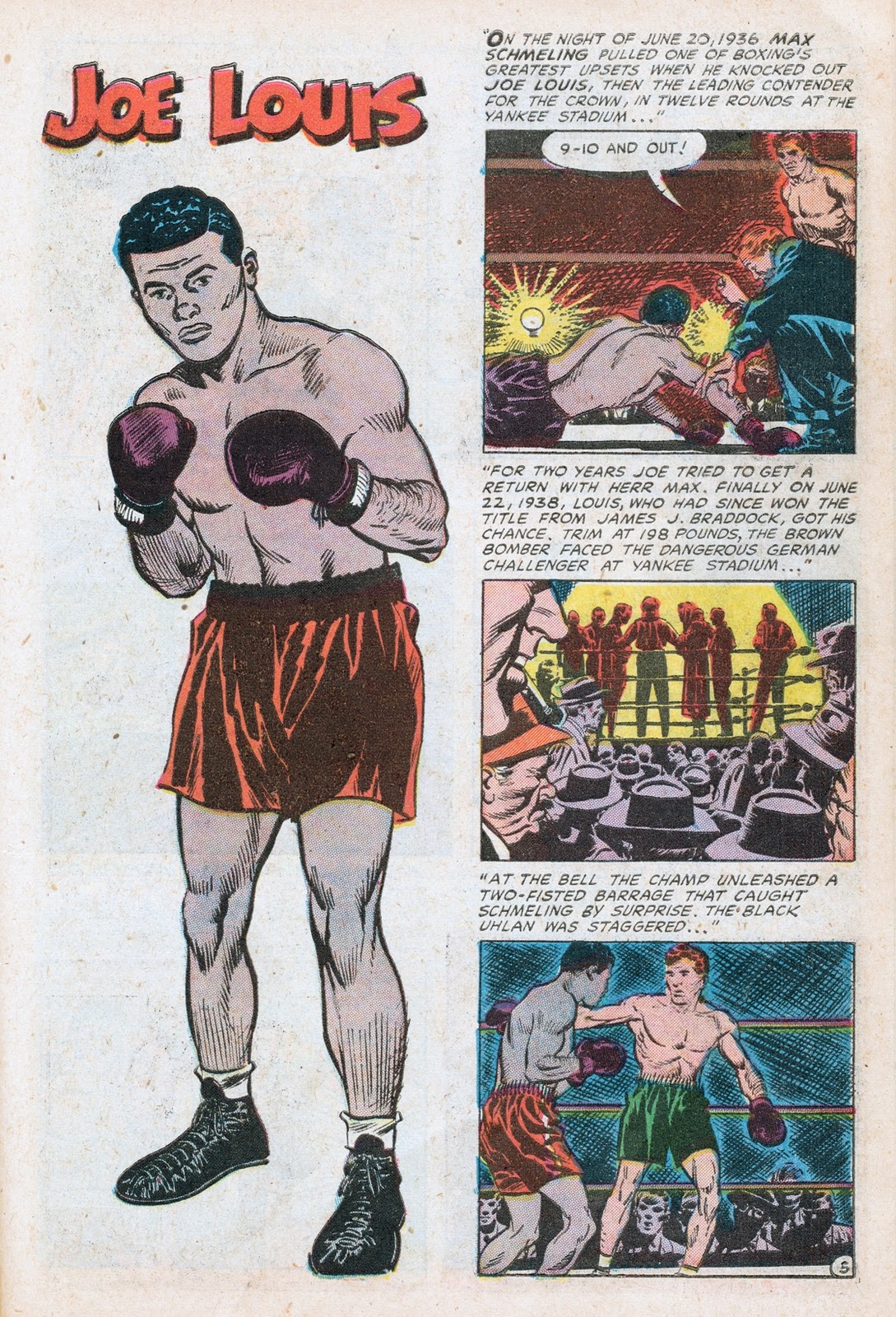
Crossing the Divide: Joe Louis (2)

This comparative look at the peaks of the respective careers of Joe Louis and Jack Dempsey in Bill Stern's Sports Book Vol.2 #2 is interesting, not least because it doesn't mention race. In 1952 when this comic was published by Ziff-Davis in a still-segregated America, it was remarkable in that it features an African American, and still more remarkable that Joe Louis is not billed as representing his race. It's refreshing to read a comic from that time that simply presents Louis as a normal, if accomplished, member of the human race. This was one approach to racial integration in comics used by some writers of Silver Age comic books later on, presenting diversity as if racial harmony was a reality in society. Interestingly, the art on this story is by famed inker Frank Giacoia.


~

Thursday, April 7, 2011

Crossing the Divide: 'Sugar' Ray Robinson

Another of the many stories in Bill Stern's Sports Book Vol.2 #2 (Ziff-Davis, Winter, 1952) features 'Sugar' Ray Robinson, whom many consider to have been the greatest pugilist of all time. Robinson was another boxer who fought in an age when successful African American sports personalities were seen as ambassadors of their race. Their success was seen as 'proof' of racial equality, in a society that was struggling to impose intelligence over the animal instinct that saw and feared difference. Robinson was friends with Joe Louis, and during WWII these two boxers played a significant morale-boosting role in the armed forces. Ironically, although in 1952 Robinson is praised highly, on the first page of this story, for sound management of his earnings, by the end of his life he was existing in poverty.

~

Monday, April 4, 2011

Crossing the Divide: The Harlem Globetrotters (1)

In the early 1950s, Ziff-Davis published Bill Stern's Sports Book, a comic book in the sports genre. Volume 2 # 2 (Winter, 1952) was a 100 page square bound 25c comic, and contained several stories featuring African American sports stars. The first in the book (and the hardest to scan!) was about the origins of the Harlem Globetrotters. Drawn by Everett Raymond Kinstler, it's an artistic gem, but it's also an interesting read as it follows the early exploits of the world's most famous basketball team. What's important to remember is that this comic was published during the period when segregation was still in force in the USA. The Globetrotters are another example of African American sports personalities who were able to induce members of the majority population previously entrenched in a dualistic stance on race, at least to some extent traverse the race barrier. Like all African American sports personalities of the time, in addition to having to make a name for themselves in their field, the Globetrotters had thrust upon them the responsibility of representing the African American community or 'race' as a whole, an unwholesome burden inflicted by a society divided along racial lines.


For sportsmen like the Harlem Globetrotters, that hard-earned recognition made its own contribution to breaking down the race barrier, even though such representation should never have been necessary in the first place. But that was how American society had evolved at the time, on its road towards making the words of the Declaration of Independence and the Constitution of the United States become a reality. Looks like the Globetrotters also had the privilege of being some of the first people to have their portraits drawn by Kinstler, for whom several U.S. Presidents have subsequently sat! Kinstler nowadays is recognized as one of the greatest portrait artists of all time.