Showing posts with label Enrique Badia Romero. Show all posts

Sunday, December 31, 2017

British Girls' Romance Comics: Valentine 1st February 1969

While on a recent trip to the UK, I visited Dave's Comics (http://www.davescomics.co.uk/) in the Lanes area of Brighton. The store is in a great, bohemian shopping area in downtown Brighton, with cafes, restaurants, and all kinds of vendors.


The thing that impressed me most about Dave's was the wide selection of back issues available at reasonable, realistic prices, aimed at encouraging rather than putting off the enthusiast. On top of that, the staff were very friendly and helpful. The store is on two floors:


There were a number of comics I would have liked to have bought, but I had to keep the bulk and weight of my luggage down, so I just opted for one comic that would be very hard to find back here in the USA.


There was a copy of Valentine hanging up on a wall display just as we entered the store, and that caught my eye. The condition wasn't so great, but I think it was well worth the £3 that I paid for it. Valentine is notable for featuring artwork by Spanish artists of the Selecciones Illustradas agency, and for stories based on the titles of popular songs. The one that I bought at Dave's was from 1969, so towards the end of Valentine's run. See what you think:


This first story looks like it was drawn by Enrique or Jorge Badia Romero, with lots of wild hair, bushy eyelashes, and very moody. Those large panels on pages two and four look like they might have been finished with a watercolor wash.

Following the opening story, the comic goes into a text-heavy section with short news articles about various stars, a two-page text story with some nice illustrations, more news and articles, and a couple of ads:


The next story again looks like the Badia Romero brothers. I'd hazard a guess that this is Jorge. Quite a treat:


The rest of the comic continues with more of the same mixture, articles focused on pop stars, interspersed with comics and some ads. But while we've seen the best of the artwork, the rest is still not too shabby:


A sign that times were changing...?


Fashion, of course...


An interesting story about a female delinquent...


The horoscope...


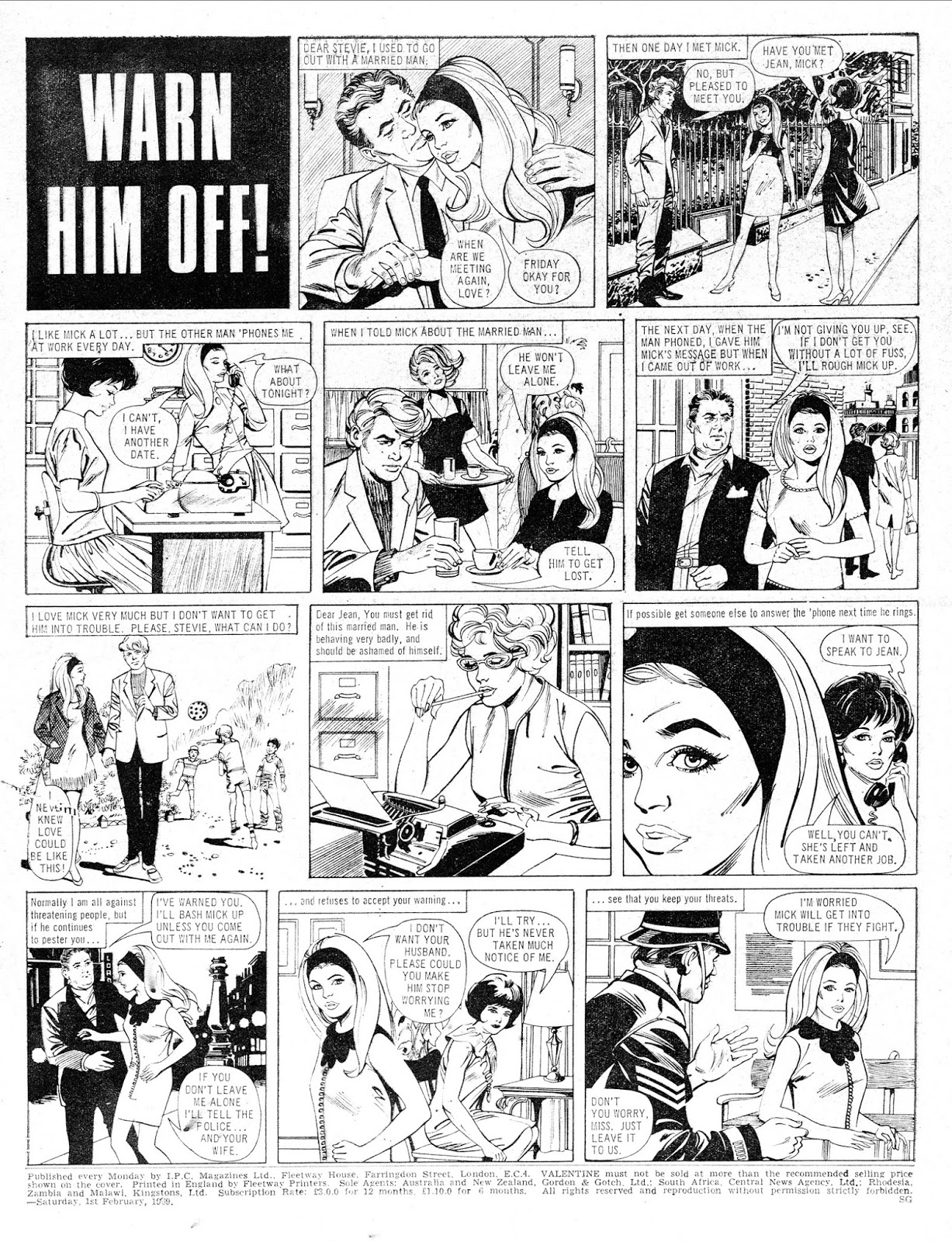
...and the problem page!


With a very interesting sequential art adaptation of a reader's problem and Stevie's response...
 
And for old Diana Rigg fans...


For those of you interested in these Spanish artists of the 1950s and later, you will do no better than buying David Roach's book, Masters of Spanish Comic Book Art.

That's all for now, folks! Happy New Year!

Wednesday, March 26, 2014

British Girls' Comics: Diana Annual 1975 and 1974 - Fabulous Four by Enrique Badia Romero

With every little bit I learn about the Spanish artists who worked for British and American comics in the 1960s and 70s, the more I realize that I don't know. These artists were/are simultaneously often very expert and accomplished in terms of the work they produced, but remain relatively poorly known, except for one or two. Enrique Badia Romero is one of the better known, but understanding even his work is complicated by the fact that he had a brother who was also a comic artist with a very similar style. Out Of This World has previously featured examples of Romero's work on British girls' annuals, and here's a couple more. First is the Fabulous Four story from the 1975 Diana Annual. When I try to define what it is that makes it Romero, I gravitate to the bushy eyelashes, the wisps of out-of-control hair, the liberally-applied eye shadow, and the pouting lips. But as those of you who like the work of Spanish artists will know, Romero isn't the only one whose women are rendered in this fashion. We're sometimes down to very subtle differences in the 'Spanish' or 'Catalan' style. And with these artists often not signing their work, the problem can get complex. So I have to say that I think, I'm pretty sure, this is Enrique Badia Romero, but I can't be 100% sure unless David Roach agrees! One thing is for sure, 'Spanish' artists deserve wider recognition for the work they did in Britain and the USA.


Now here's the 1974 Diana Annual Fabulous Four story. Was it the first? I don't know. The art looks similar to the 1975 story, but different at the same time. Does it represent an earlier phase in the evolution of the same artist? Is it more restrained, deliberately, because the artist was attempting to test the water? The characters certainly look younger. Is it by Romero's brother? Different inker? What do you think?


I don't have any more Diana annuals, so I think that's the last we'll be looking at the Fabulous Four here on Out Of This World. But watch out for more work by Spanish artists in upcoming posts.

Saturday, February 8, 2014

Enrique Badia Romero - Axa, from Il Mago #96, March 1980

Enrique Badia Romero is best known for his newspaper strips, especially Modesty Blaise. His work on Axa probably comes in second in terms of recognition, but as you can see from the examples below, it's superb. These are three pages from a section of newspaper strip reprints in an Italian fumetto called Il Mago from around about 1980. There are (or should I say were) reprint collections available in English and some are still obtainable at non-astronomical prices on Amazon, but I guess they are all way out of print. Time for Fantagraphics to put together a new edition?


I don't know about you but I want to know what happens next! The sword and sorcery genre, which Axa seems to be part of, is one of a number of Bronze Age innovations or revivals that mark a shift in comic reader tastes happening at the end of the 1960s and into the 70s. That change doesn't seem to be coincidental, given the goings on in society - Civil Rights, Feminism, anti-war movements, and general discontent with what had been the status quo. The beginnings of the Bronze Age in comics appears to be a period worthy of further in-depth study, for both its creative achievements as well as what it might tell us about our society at that important time. As I have been focusing over the last few years on desegregation in American comics, that much has become increasingly apparent the more I study.