Showing posts with label Jack Kirby. Show all posts

Thursday, February 17, 2011

Social History in Comics: Our Fighting Forces 159 - "Mile-a-Minute Jones!"


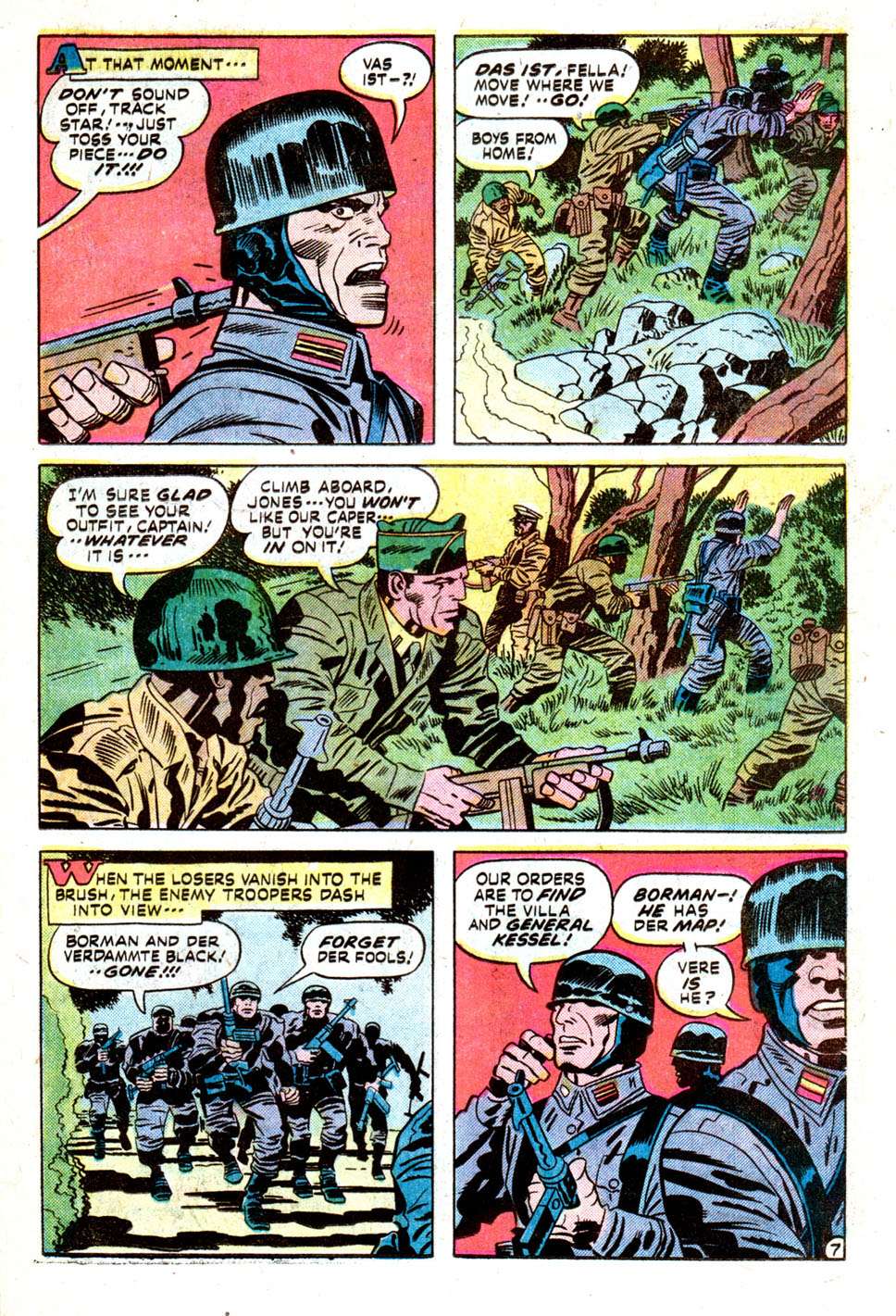
A Jack Kirby Losers story in Our Fighting Forces 159 (Sept 1975) features a one-off appearance of Mile-a-Minute Jones, an African American soldier. Kirby appears to have played on Bob Kanigher's idea of making Jackie Johnson a world heavyweight boxing champ like the real life Joe Louis from the mid-20th century, by modeling his character on Jesse Owens, the Olympic champion athlete who won golds at the 1936 Games in front of Adolf Hitler, much to the Fuhrer's annoyance.

Jesse Owens starts the 200M at the Berlin Olympics in 1936

The story begins with a group of Nazis coming across an American truck that's been blown up. They check for survivors, anticipating there to be none, but they reckoned wrong. Henry Jones, star track athlete, makes his break for freedom, eluding all of his would-be executioners save one, who also shares his fleet-footedness. Turns out this mercurial Nazi is none other than Henry's old opponent in the Olympic Games, Bruno Borman. Also like Kanigher's Easy Co. story, in which Jackie Johnson slugs it out on the battlefield with his old opponent from the boxing world, here two more old sporting opponents meet in battle in WWII.


Bruno's link with Henry is that strong that he plans to make sure the other Nazis don't kill him. Whether he would have succeeded or not, we'll never know, because it's at this point that The Losers intervene, rescue Jones, and capture Borman, who happens to be holding the map his comrades need for their mission.


The Losers have a plan to capture the Nazi general, and they succeed. The other Nazi soldiers are left imprisoned, while The Losers seek to escape the area with their more valuable prize. Those Nazi troops escape, however, and the speedy Bruno catches up with The Losers and sprints across an open field to tip off the German paratroop patrol he spots in the distance.


As the only one fast enough to have a chance of catching Borman, Jones sets off in pursuit.


Jones relives the experience of being out on the track against Bruno. Just as in the 1936 Olympics, Jones again feels the urgency of undermining the Nazi claim of white racial superiority by running faster than Borman. He gains on Borman, but it reaches the point where he has to make his move if he's going to stop him in time. He leaps, but falls short. The paratroopers are alerted.


As the Nazi paratroopers turn in pursuit of The Losers, they get a deadly surprise - somehow Bruno and Henry had sprinted across a minefield unharmed, but the paratroopers are not so fortunate.


The engineer's tape that had marked the only safe route across the field had also acted as a kind of lane marker for Henry as he ran.


The Losers' ride out of this danger zone arrives. But despite escaping, Henry feels sadness due to the loss of his competitor, who lies dead on the battlefield. There will be no more contests on the track between Mile-a-Minute Jones and Bruno Borman.


The story, written by Jack Kirby, is straightforward, and makes a simple point. Along the way we've seen the Nazi assumption of racial superiority again exposed. Although little was made of it at the beginning of the story, the American truck that had been blown up was manned by an African American segregated supply unit, by the looks of it, again bringing into the picture the paradox of segregated America fighting to defeat Nazi racists in an anti-racist war.

Saturday, January 29, 2011

Social History in Comics: New Heroic Comics 81 - "Hill 528"


The significance of New Heroic Comics 81 (March 1953), published by Famous Funnies, is that it contains a short true story about the bravery of Corporal Fred McGee in the Korean War. Corporal McGee is still alive today, and is a decorated veteran of the Korean War. In this two page story depicting the events on Hill 528 for which Corporal McGee received his honors, McGee is not shown as an African American, even though that is his identity. Personally I think it is unlikely that this omission was deliberate on the part of the comic book creators. It is more likely that it was simply assumed that McGee was white, because in the early 1950s, institutional racism, if nothing else, tended to make society blind to the contributions of African Americans. It was as if a whole section of the population didn't exist, and you can see this by the absence of African American characters in comics throughout the 1950s especially. The error made on this comic is reminiscent of that made by the Marvel colorists on the cover of Sgt. Fury 1 in the early 60s - they simply assumed that all the characters were white, unaware of Lee and Kirby's intention to introduce diversity into the Marvel universe. Here then is "Hill 528". I wish that somebody who is a comic book creator would re-do this short story with McGee correctly depicted as an African American, and publish it somewhere while McGee is still alive.


As a special treat, here's the inside back cover of the comic, which features a Boy Scouts of America National Jamboree ad drawn by none other than Frank Frazetta!


Also, just to complete this short post, here's the cover of Sgt. Fury 1, showing the incorrectly colored Gabriel Jones:


Gabriel Jones is the famous African American horn-blowing member of the Howling Commandos.

Tuesday, September 14, 2010

Nurses as Supporting Characters: Young Brides 17 - "Act of Faith"


The interesting cover of this issue of Young Brides points to a different story that I'll hopefully get time to scan one day. Here we'll take a look at a medical romance story in the issue that features a doctor, with a nurse only playing a minor supporting role. Douglas Wilson is a newly qualified young doctor and husband, who fails to save his wife when she succumbs to peritonitis from a burst appendix. He blames himself for her death, quits the medical profession, and joins a traveling carnival as a mechanic (I'm sure I've read a few Simon/Kirby stories in which roustabouts and circuses feature!). After a while a young woman, Diane, falls for him, but Doug restrains himself from getting involved, even though he's attracted to her. His hand is forced when she becomes the victim of a violent ex-employee of the carnival, and Doug has to come out of the medicine cabinet and use his skills to save her life. That's the turning point, and he is able to move past his grief at the loss of his first wife, marry Diane, and resume his work as a doctor.


The story is narrated by Doug, so it is in the minority as far as romance comics are concerned, in which the 'confessions' usually come from the woman. The image of nurses portrayed in this story is that of the Doctor's Handmaiden. She serves the doctor by following his orders and performing support duties such as taking calls. She's professional in her appearance and conduct, and in this story she's not in love with the doctor!

Wednesday, June 9, 2010

Nurses At War: Young Romance 78 - "Army Nurse"

It took me some time to get this book. These Simon and Kirby post code issues are fairly tough to find. The cover is directly related to the nurse romance story that I am interested in here, set in a Mobile Army Surgical Hospital in Korea. The art is by Argentinian artist Jo Albistur (signed).

In "Army Nurse", the nurses all love Doctor Roy, but the Doc only has eyes for one of them, and that's Joyce. He's been preparing to pop the question, and does so after a hard day's work. Joyce is over the moon to be engaged to her dream boat.
For some reason Roy keeps quiet about why he seems to always be giving Ruth Duryea assignments to work with him. Sure, he gives some plausible explanations - she's new and needs the training - but it doesn't quite all add up. Suddenly Joyce is snapped out of her jealous fog by the news that Roy's aircraft has gone down, and he's hurt. Joyce immediately volunteers to be the nurse to travel to the crash site. On the way the flak from the North Koreans almost makes her wish she'd stayed back at the camp, but she gets there to find Ruth tending to her intended. This is a bit much for her to take, and she removes her engagement ring from her finger and slips it into Roy's pocket, her dream perhaps over. Setting aside her jealousy, Joyce does the needful. Back at the M.A.S.H. Roy is operated on. However, afterward Ruth flies in and is assigned to the care of the wounded. It is then that Joyce discovers something that changes the whole picture.
Ruth has no romantic inclinations towards Roy. She's already married to the injured sergeant, secretly, because it's against regulations. Doctor Roy Nelson knew and has been covering for them. Joyce realizes what a chump she's been and fumbles in Roy's pocket to get her ring back. He's already ahead of her though, having found the ring there himself. He sees that his position, surrounded by a flock of marriageable, lovely nurses makes life difficult for Joyce, and so he prescribes the only reasonable cure - a wedding.
I like this artwork by Jo Albistur. I think I have another example of his work somewhere. He's mentioned on the Simon & Kirby Museum blog. It reminds me somewhat of Al Williamson's work. The image of nurses presented by this piece include the usual - aspiring for romantic involvement with a doctor, bitchy rivalry, they're all pretty in their nicely starched white uniforms and caps. These are nurses at war so there's bravery and willingness for self-sacrifice. Nice switch to the blue uniform for going out into the battlefield. Ruth Duryea is a redhead for the cover but blond in the story. Panel 7 on page 5 looks like it was intentionally drawn to match the cover, and is a little out of Albistur's natural style as a result (the cover looks Kirby or Simon/Kirby to me).

Saturday, April 3, 2010

African American History Month Reprise: Sgt. Fury 6 - "The Fangs of the Fox"

Central to any consideration of the introduction of African American characters into mainstream comic books of the 1960s has to be issue #6 of Sgt. Fury (March 1964), a Lee/Kirby masterpiece with inking by George Roussos. The whole series promotes a view of harmonious relations between all ethnic groups and races in America as desirable, simply by virtue of the diversity of the Howling Commandos themselves. You have a Jewish American (Izzy Cohen), Italian- (Dino Manelli), Irish- (Dum-Dum Dugan), African- (Gabriel Jones), and originally three Anglo-Americans, two from the north (Fury himself and Junior, who gets killed early in the series) and one from the South (Rebel Ralston). But issue 6 of this series is one that takes the bull of racism by the horns, brings it out in the open and slays it for all to see.
As the cover suggests, the story is "based on a little known incident of the North African campaign", so right away you know Rommell and the Afrika Korps are going to be part of the tale, and Monty's British Desert Rats are going to show up at some point. The expertise with which this story is written, though, is evident from the way the reader is led to believe that the mission to get Rommell is the main plot, and that the racist issue is a sub-plot - it's not evident at all from the cover. By the end of the book the former fizzles out and the latter provides the main punch. The story was clearly written to get a strong point across on racism.

Back to the story of issue 6. Leaving aside the details of the mission, just suffice to say it's all going on in North Africa, the Howlers are given a replacement for Junior who was lost two issues previous. Fury notices something strange about the new guy, George Stonewell. First of all Fury puts it down to their new man maybe trying to impress him with his toughness, now that he's with the Howling Commandos, but when they enter the barracks all is revealed:
Fury sure doesn't mince his words. Notice how Stonewell assumes that 'Rebel' is a racist because he's from the South. In Wally Wood's "Perimeter" (Frontline Combat 15 by EC, Jan 1954) Wood used a similar scenario to undermine the stereotype of all Southerners being racists. In fact this story feels like it draws a lot of inspiration from Wood's 1954 standard setter.

Now as I'm sure anyone in the armed forces will tell you, the most important people to any soldier are the other members of his/her unit. I hasten to add that I do not speak from direct experience here, but from what I have learned from a colleague who is a veteran. Their lives are inter-dependent at a level most other people don't experience. So disharmony is, unsurprisingly, a danger to everyone concerned. A couple of times during this story the point is made that racial disharmony is a direct threat to the lives of soldiers - Stonewell, in considering himself superior to Izzy and Gabe, doesn't think them capable of handling the mission, and his clumsy attempts to take over their roles nearly gets them killed a couple of times. Here's the first incident, where mistrust of Gabriel's abilities almost ends in disaster and does reach a flashpoint between Jones and Stonewell that Fury has to break up and suppress with some serious threats:
In a kind of interlude, because Stonewell speaks German, Fury wants to use him to communicate with a captured Nazi officer. It is during this conversation that Nazi anti-semitism and racism against African Americans back home are equated:
Then comes the incident in which Stonewell tries to take over Izzy's role because he thinks Jewish people are incapable inferiors. Again this exposes the two commandos to unnecessary danger, as their conflict alerts the enemy to their presence. Yet when the chips are down the two fight as a team, and Stonewell deals the blow that frees them from their immediate danger, but in the process he's hit by grenade shrapnel. Izzy has to carry him to their rescue by Fury and the rest of the unit:
So now comes the final anti-racist message, using the same blood transfusion idea seen in the Our Army At War 160 story "What is the Color of Your Blood?" (November 1965) featuring Jackie Johnson and the Nazi heavyweight boxer. Gabe has the same rare AB blood type as Stonewell, who won't survive without a transfusion. Sgt. Fury 6 predates OAAW 160 by 18 months, but Bob Kanigher was using the blood transfusion theme in his Sgt. Rock stories well before this issue of Sgt. Fury. Remember the story "A New Kind of War" (March 1961) featuring Sgt. Rock and the nurse in Our Army At War 104, where she offers her blood to save Rock's life? In that one I think the point was being made about the bravery of nurses in war, and their willingness to sacrifice part of what keeps them alive, or even their own life, for that of their patient. Here the blood transfusion is being used to show that there's no difference between black and white. It makes the 'one drop of blood' rule look ridiculous.
The final page sees Stonewell preparing to depart, reassigned after making his recovery thanks to Gabe, and being saved by Izzy, the two men whose racial and ethnic backgrounds had led him to despise them. Stonewell has changed, but he's not fully reformed by any means. It's taken a lifetime of conditioning to turn him into the bigot he is, and in his case it isn't something that is going to go away too easily. But there's hope, and the last panel summarizes the message the story was putting across.
So ends one of the few major anti-racist comic books of the decade, the first in the 1960s to directly and openly confront racism.

Saturday, February 13, 2010

War Comics Introduce Racial Integration: Tales of Suspense 61 - "The Strength of the Sumo"

Although Tales of Suspense isn't a war comic, the Captain America story in issue #61 (Jan 1965), set as it is in Vietnam, temporarily qualifies the title as one. This particular story stands out as an anomaly - disconnected from story arcs preceding or following it. It is unique in that it is the only pro-involvement Captain America Vietnam story, and one of only a handful of Marvel comics that touch on Vietnam during the period of American involvement in that arena. It is also special in that, seemingly out of the blue (or the red, white, and blue even!) the story contains a piece of retroactive continuity to justify Cap's trip to the war zone. He's there to rescue an African American chopper pilot who's been captured by the Viet Cong. For Cap this mission is a return favor, because the pilot's brother rescued Cap during WWII. That's another reason why this comic is special - Except for DC's Our Army At War and Marvel's Sgt. Fury, no other mainstream comics up to this point in time had featured non-stereotyped African American characters. With it's publication coinciding with increased American involvement (Operation Rolling Thunder was implemented in Feb 1965) and the deployment of ground troops in Vietnam that followed, there's an underlying symbolism running through this story that adds up to one of the finest pieces of propaganda in sequential art form I've ever seen in comics, at least partly aimed at encouraging African American enlistment.

Upon allowing himself to be captured, Captain America begins his exchange with the Viet Cong by asking, “Is the communist fighting man so weak, so unsure of himself, that he fears one lone American? Is this the much-vaunted power of the Viet-Cong?” The Viet Cong soldier responds: “Still your tongue, costumed one! Even we have heard of the prowess of Captain America! We will not be as easy to trick as you may hope!” Prophetic words indeed, although at the time they were meant to both bolster pride in America and suggest foolhardiness on the part of the Viet Cong. Notice the full-bearded, very Russian-looking major!
As Captain America is taken to the location of the captured African American chopper pilot, he sets up the reader for one of the messages underlying the story by stating, “He IS important…to me! I owe him a very great debt!” Years after World War II, here is America (Captain America symbolizes the conglomerate of values underpinning the republic) acknowledging the role of African American servicemen in World War II, and encouraging and anticipating their repeat involvement, this time in Vietnam. Being there himself, Kirby would certainly have been aware of the part African American soldiers played in supplying Patton’s sweep across Europe during WWII. In this story, the communists continue to reveal their ignorance as to the true power of America whilst simultaneously confirming their hostility through insults aimed at the USA.

The eventual meeting between Captain America and the African American pilot, Jim Baker, is highly symbolic.

Captain America: Jim Baker! I’ve found you at last!
Jim: Cap! They’ve caught you too! I can’t believe it!
Captain America: I’m not caught, son! I’ve come to free you!

Captain America explains that they will find a way out of the predicament, just as Jim’s brother found a way to rescue him years ago.

Captain America: I owe this to him, Lieutenant…and to you! And by all I hold dear, I swear to you that my debt will be paid!
Jim: But the entire world needs you, Cap…!
Captain America: It needs you too, Son! It needs ALL of us!
 
The story continues with a battle between Captain America and a sumo wrestler several times his size, who has underestimated the Captain’s strength – more propaganda convincing the reader that, although confronting the communist Vietnamese is a big undertaking, America is more than up to the task and the Viet Cong don’t understand what they are in for.

Sumo: I am twice your size! Three times your weight! To me you are no more than a bothersome flea! You waste your strength! Even though you may rise to your feet, you can never get free of my unbreakable hold!

Vietnamese soldier in the background: The American’s strength is greater than one could imagine!

Here the reader is reassured that America has the strength necessary for the task and that the Vietnamese have bitten off more than they can chew although, of course, subsequent real life events did not support this analysis of the situation. The use of a sumo wrestler is also a subtle device to connect, in the mind of the reader, the Vietcong of the Vietnam conflict with the Japanese enemy of World War II. Although Vietnam has its own traditional form of wrestling, Sumo is part of Japanese culture and its out-of-context use in this Vietnam Captain America story helps to place the Vietcong in the same category with reference to communism as the Japanese occupied with reference to Nazi Germany in World War II – connected to, even allied with the principal enemy.
The final page of the story adds a subtle piece of stigmatization of the Vietnamese as ‘idol-worshippers’, a negative label for the minds of the predominantly Abrahamic religion-following West, followed by a deliberate attempt to connect, again in the reader’s mind, the Viet Cong with the Soviet Union, by having Captain America and Jim escape in a commandeered Mig jet. At the end of the story Jim is thanking Captain America, who responds in modest fashion – the true spirit of America taking credit quietly for the final freedom of African Americans in the age of the Civil Rights Movement – it’s been there all along behind the scenes, fighting for liberty and justice for all. The final panel finishes with an ad for Sgt. Fury 13, where the reader will learn why Captain America was the greatest hero of all during the Golden age of Comics, a not-so-subtle claim to predominant American glory in World War II.
Although this story represents a really fine piece of subtle yet powerful propaganda in sequential art and narrative by Lee and Kirby, it is the one and only time Marvel Comics endorsed the anti-Vietcong sentiment behind the war.

Note: much of this post was re-written from part of my chapter in the book Captain America and the Struggle of the Superhero. I'm revisiting this particular story for my upcoming presentation on the integration of African American characters into mainstream comic books, arguing that the story seeks to counteract anti-Vietnam involvement sentiments present in the African American community due to, among other things, statements made repeatedly by the Nation of Islam and Malcolm X against any American involvement in Vietnam. Malcolm X gave a famous speech in Feb 1965 to this effect, one month before his assassination. Kirby has been quoted elsewhere in relation to the introduction of the Black Panther that Marvel were aware of an African American base within their readership. Given the message this story puts out encouraging African American involvement in Vietnam, it seems timed to address the anti-war sentiment in the African American community, using a kind of Civil Rights integrationist rhetoric to imply a brotherhood of Americans of all races united against the communist threat.