Showing posts with label Joe Kubert. Show all posts

Friday, May 1, 2015

Spaghetti Western Fumetti: Tex

While western comics went out of fashion in the late 1970s here in America, in Italy the genre is not only alive and healthy, but thriving. The top-selling western, and one of the most popular comics in Italy, is the long-running title, Tex. Ongoing since 1948, with current print runs in excess of 200,000 copies per issue, it lasted far longer than even the longest running American western titles, such as DC's Western Comics or Marvel's Kid Colt! At its peak it was selling 700,000 per month! There is actually nothing comparable to this giant in the western genre in the USA and I'm guessing anywhere else. Ironically, the characters in Tex present a far more accurate picture of the true diversity of the Wild West than American western comics ever did. We see Black, Mexican, American Indian, and white cowboys working together, as it was in the real history of the West, but not as most twentieth century media portrayed it. Moreover, these characters are presented respectfully, with some hint at the true depth and complexity of American Indian culture. Racism is not prominent in this Wild West, just as in the real West of America, when it was beyond the borders of the Union, and even up until Jim Crow began to bite, when Black people could start a new life relatively less encumbered by the oppression prevalent in the States.

And these are not small comics, in terms of pages. Not the more modern issues anyway. They're each as long as an American graphic novel! Tex was originally created by Giovanni Luigi Bonelli (writer) and Aurelio Galleppini (artist). I believe the editor, Sergio Bonelli, is quite a celebrity in Italy. Of the dozens of artists who have worked on the book during its 67 year history, only one appears to be American - the great Joe Kubert was the guest artist on Tex Special #15 (I'm getting my information from the Italian Wikipedia at this point!).

Tex Willer is a leader in the Navajo tribe, having married a Navajo woman, Lilyth. So Arizona of the 1880s is the main setting in the original comics, but over the years stories have taken place in surrounding areas such as New Mexico and Texas, and far further afield places like Alaska and Colombia.

Here's a couple of examples that I collected on recent trips to Venice. The first is one that I found in a second hand bookstore. It is a large, 240 page, Tex Annual #27 from 2012. Only the covers are in color, but the interior black and white art is exquisite. The cover and interior art of this one is by Fabio Civitelli, the story by Mauro Boselli. The title of the story literally seems to be "The Ride of the Dead," but it could be more like "The Trail of the Dead."


My Italian is practically non-existent, so I can only actually read the comic using Google Translate, a very slow and unsure process. Nevertheless, I've picked a couple of interesting looking pages (120 & 121) and tried to translate. Here goes:
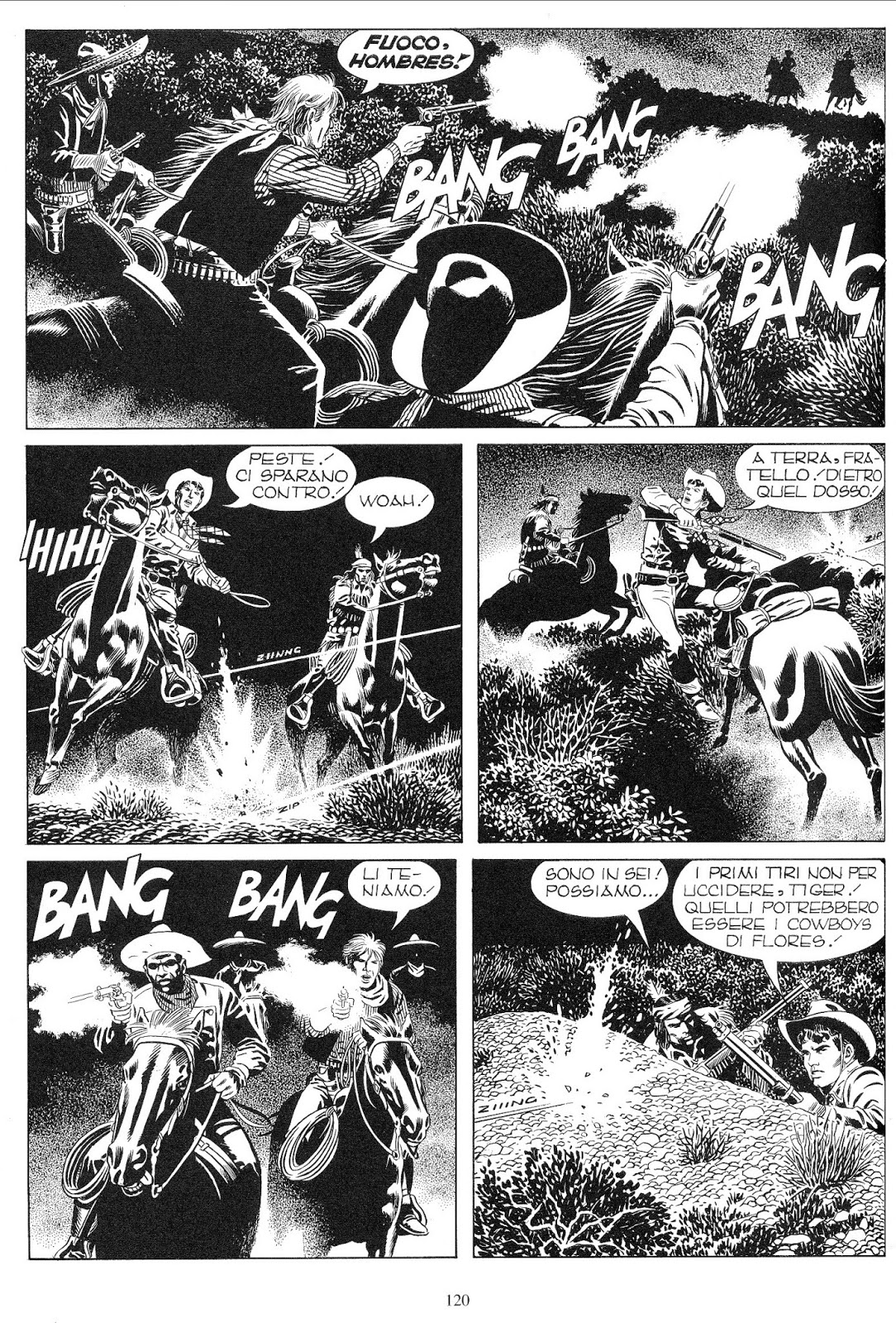

Cowboy #1: Fire, hombres!

Tex: Vermin! They're shooting at us! On the ground, brother! Behind that rock!

Cowboy #1: We've got them!

Tiger Jack: There's six of them! We can't...

Tex: Those first shots were meant to kill, Tiger! Those could be Flores' cowboys!


Tiger Jack: Bah! In my opinion this is a waste of lead!

Cowboy #1: Lightning!

Tex: Stop! Or we'll start getting serious!

Cowboy #2: Madre de Dios!

Cowboy #1: They shoot like devils! What do we do, Ray?

Ray: There's not much we can do! We went in without thinking and now we're at their mercy! Let's hear what they have to say!

Tex: Are you the cowboys from "Agua Escondidas" ["Hidden Water"]?

Over the next few pages Tex and his blood brother, the Navajo Tiger Jack, appear to make friends with this group of initially hostile cowboys. I didn't try to translate these next example pages (144 & 145) but a lot can be inferred from the visuals:


That annual had magazine-size pages. The monthly issues of Tex, however, are Italian digest-size, a little bit larger than the American digest (e.g. the Archie digests). Here's an excerpt from Tex Monthly #639 from January, 2014. The title is "In the Slums of San Francisco." My translation here is probably worse than the one above, but hopefully gives some idea as to what is being said.


Some more of the main or support characters in the series are featured here. There's Tex's son, Kit Willer, and also Lefty Potrero, an ex-fighter who owns the Hercules Gymnasium in San Francisco (in the story).


Tiger Jack: For Manito! They're talking about a woman hostage! Who can she be? I have to go back to warn Kit and Donen! But not now! People are coming!

Strongman#1: Here's the place!

Lefty: A real den of rats!

Strongman#2: Don't wait to... [totally unsure what this means]

Lefty: Quiet boys! You have to use your brain here, not your muscles!

Strongman#2 Uh!

Lefty: If we're not careful, these particular rodents would scram under our noses... and I don't think in that case Tex would be very grateful.


Strongman#1 [Bingo]: But if we go in acting normal and look around?

Lefty: Mmm...
---------------------------------------------------------
Kit: That's Lefty Potrero and his strongmen from the Gym! What the hell are they doing? If they all go in there together they will arouse suspicion!

Donen: You can't tell them what to do, Kit. The success of the plan depends on whether you and I can always stay in the shadows!

Kit: And are your motives true, Donen? Thirst for adventure and desire for revenge? Or because you are ready to join the army of God?

Donen: Why did you agree to it if you doubt me so much, Kit?

Kit: My father trusts you... and then... you're not the only one who loves the thrill of the unexpected, amigo!


Lefty: Okay! You're right, Bingo! Enter in groups of two or three to avoid attracting too much attention... and keep your eyes peeled for those four in the description, guys!

Strongman#3: Okay, Lefty!
---------------------------------------------------------
Notice how the whispering on p.58 between Kit and Donen is indicated by word balloons with a hashed line!

Well, I hope you all found something interesting in this introduction to an Italian institution! For further introductory reading on Italian fumetti please check out the following Out Of This World blog posts:

On the Trail of Fumetti

Spaghetti Western Fumetti: Lanciostory A.5 #26 - "Come Coda di Volpe Divenne Bandito"

Out Of This World leaves you with a selection of Tex covers from the 1960s and 70s. Enjoy!


Tex #69

Tex #91

Tex #99

Tex #103

Tex #104

Tex #107

Tex #108

Tex #151

Thursday, March 1, 2012

Social History in Comics: Blitzkrieg 2 - "Walls of Blood"


Robert Kanigher, a long-time writer for DC, can be observed over his career to have been a name more often associated with anti-racist messages in comics than other writers of the time, and he often teamed with artist Joe Kubert on DC's war books. Blitzkrieg was a rather controversial book with the publisher (Joe Kubert, personal communication) that took a look at World War II from a Nazi perspective. This issue (#3, Mar-April 1976) is particularly hard-hitting in the way it depicts the callous slaughter of Polish Jews by inhuman Nazis. With a cover by Joe Kubert and interior art by Ric Estrada, the artwork is meritorious. The comic is one of a number of anti-racist war comics published by DC through the 1960s and well into the 1970s. Overall, when this particular body of work by Kanigher is examined, it is possible to see a theme of equating racism against African Americans with the anti-Semitism and other prejudices of the Nazis, the bottom line being that okay we despise, and rightfully so, the racist atrocities committed by the Nazis, and this is an incompatible position to take if we don't simultaneously condemn racism against African Americans and racism generally. It's also the approach adopted by Stan Lee and Jack Kirby at Marvel (see especially Sgt. Fury and His Howling Commandos #6). I found this issue of Blitzkrieg a bit uncomfortable to read because of the reality behind the story - it's painful to even begin contemplating the human suffering that really did take place at that time.


Heavy stuff, and it barely begins to convey the full horror of what went down, even though as a piece of popular media, it does a lot to make the reader think about the Holocaust, more than most material from the mid-1970s.

Saturday, February 12, 2011

Social History in Comics: Star Spangled War Stories 179 - "A Town Called Hate!"


With Archie Goodwin as editor, this issue of Star Spangled War Stories (179, March 1974) features an Unknown Soldier story that exposes the intense racial infighting that had been a serious problem in the U.S. military during the Vietnam conflict, using a WWII setting. In the Armed Forces Journal in 1971, Col. Robert D. Heinl, Jr. wrote:

"The morale, discipline and battleworthiness of the U.S. Armed Forces are, with a few salient exceptions, lower and worse than at any time in this century and possibly in the history of the United States. By every conceivable indicator, our army that now remains in Vietnam is in a state approaching collapse, with individual
units avoiding or having refused combat, murdering their officers and non commissioned officers, drug-ridden, and dispirited where not near mutinous. Elsewhere than Vietnam, the situation is nearly as serious. Intolerably clobbered and buffeted from without and within by social turbulence, pandemic drug addiction, race war,
sedition, civilian scapegoatise, draftee recalcitrance and malevolence, barracks theft and common crime, unsupported in their travail by the general government, in Congress as well as the executive branch, distrusted, disliked, and often reviled by the public, the uniformed services today are places of agony for the loyal, silent professionals who doggedly hang on and try to keep the ship afloat."

Col. Heinl paints an extremely disturbing picture. He points out, "It is a truism that national armies closely reflect societies from which they have been raised. It would be strange indeed if the Armed Forces did not today mirror the agonizing divisions and social traumas of American society, and of course they do." It's easy to forget (for those of us who lived through the period) how troubled society was at the time, as the so-called 'Swinging Sixties' gave way to the disillusionment of the 1970s.

He goes on to say, "Internally speaking, racial conflicts and drugs... are tearing the services apart today."

The Colonel provides examples of racial troubles within the military, both in Vietnam and elsewhere. While it seems clear that the eruptions of actual racial violence usually but not always originated with the African American personnel, there is no discussion of any racist treatment which might have provoked such outbreaks, but of course one has to assume that at some point this existed, if not in the moment then historically. Col. Heinl writes:

"Racial conflicts (most but not all sparked by young black enlisted men) are erupting murderously in all services...As early as July 1969 the Marines (who had previously enjoyed a highly praised record on race) made headlines at Camp Lejeune, N.C., when a mass affray launched by 30-50 black Marines ended fatally with a white corporal's skull smashed in and 145 other white Marines in the sick bay...Even the cloistered quarters of WACs have been hit by racial hair-pulling. In one West Coast WAC detachment this year, black women on duty as charge-of-quarters took advantage of their trust to vandalize unlocked rooms occupied by white WACS. On this rampage, they destroyed clothing, emptied drawers, and overturned furniture of their white sisters."

There is little in the Colonel's report in terms of reassurance, but he does observe, "All services are today striving energetically to cool and control this ugly violence which in the words of one noncommissioned officer, has made his once tough unit divide up "like two street gangs.""

He finishes his entire piece with a general observation on all the factors he has described that were contributory to the dire situation in the military, of which racial in-fighting was admittedly only one aspect, albeit a major one: "...many a thoughtful officer would be quick to echo the words of BGen. Donn A. Starry, who recently wrote, "The Army can defend the nation against anything but the nation itself." Or -- in the wry words of Pogo -- we have met the enemy, and they are us."

Three years after Col. Heinl wrote that frightening assessment of the state of affairs in the military, the problem was clearly still in the public consciousness, and became the subject of this Unknown Soldier story, "A Town Called Hate!", written by Frank Robbins and illustrated beautifully by Jack Sparling.


When a segregated African American unit comes into town and meets a segregated white unit in the local eatery, the racial tension level spikes through the roof. That night, some soldiers in the all African American unit are mercilessly gunned down, by an assailant whose identity is unknown to the reader at this point.


After what went on earlier, the African American soldiers are in no doubt as to who the perpetrators of these murders are, and exact their own fatal revenge:


The Unknown Soldier already has a mission, but once the news of the racial conflict amongst the troops reaches headquarters, it looks like he's going to have another task. The exchange between the African American sergeant, the Unknown Soldier's aide, Chat Noire, and his commanding officer reveals racial tension present at all levels in the ranks.


For the time being, however, and very ironically, the racial conflict works in favor of the U.S. forces. The group of Nazis disguised as G.I.'s, that the Unknown Soldier has infiltrated, reaches the town. Still seeking vengeance, the African American unit mistakes the Germans for the hostile white U.S. soldiers. In taking them prisoner they find out they're Nazis, and also that they've contacted the Unknown Soldier.


Chat Noire rolls into town in the nick of time to quell the racial conflict amongst the U.S. troops. Evidence then emerges that appears to indicate that disguised Nazis shot the African American soldiers, hoping to divide the Americans against each other. Sufficient unity is recreated to turns everyone's attention to the Nazi onslaught, and succeed:


While the point has been made that racial divisions in the military are counterproductive to the mission of our armed forces, there's a kind of disturbing epilogue that only the Unknown Soldier and Chat Noire are party to. In surveying their dead after the battle, the corpse of one white soldier is found, still clutching the German weapon he'd captured, used as his own, and which had become a kind of trademark lending it's name to him as a nickname. Those German cartridge cases found at the scene of the initial crime that sparked the racially polarized battle within the U.S. forces now take on more meaning. The white unit bought the Nazi infiltrator explanation because they knew it really was one of their men who carried out the shooting. The African American unit were convinced by the evidence that they had been hoodwinked by the Nazis. But the real truth was that it had been a racist white soldier who had gunned down his African American comrades in cold blood, and the engineers' initial deductions had been correct. For the sake of the war, the problem was solved temporarily, but the racial divisions still existed.


This story picked up on this racial conflict in the military theme that had originally been brought to light in comics by Harvey Kurtzman and Ric Estrada's "Bunker!" in Two-Fisted Tales 30 (Nov-Dec 1952), from over 20 years earlier. According to Col. Heinl, racial conflict within the U.S. military had a long history, dating back to the beginning of the 20th century. He noted, "Racial trouble is no new thing for the Army. In 1906, after considerable provocation, three companies of the 25th Infantry (a colored regular regiment) attacked white troops and townspeople of Brownsville, Texas, and had to be disbanded. Among the few pre-World War II War Department records still heavily classified and thus unavailable to scholars are Army documents
on racial troubles."

America's struggle for racial equality and integration has, on the one hand, been a source of criticism of the American people. But looked at another way, and I would say a more accurate way, it is the struggle of a nation at the forefront of developing a more enlightened, more advanced civilization. This struggle is seen in America because it is here where racism has been challenged by both white and black, and where the fight is on the front line. Where America has already trodden, other countries have yet to follow. While there are undoubtedly many areas of progress still to be made, I would argue that there is no nation on Earth that has advanced as far as the USA in developing a harmonious multi-racial, multi-cultural society, despite whatever shortcomings we still have to address. Comics like this issue of Star Spangled War Stories, that bring important issues out into the open, have played their part in the progress that has been made.

Friday, February 4, 2011

Social History in Comics: Our Army At War 179 - "A Penny for Jackie Johnson!"


This Kanigher/Kubert Jackie Johnson story in the April 1966 issue of Our Army At War (179) is reminiscent of the Lee/Kirby story in Sgt. Fury 6 of a few years earlier. One of Bob Kanigher's specialties was the writing of anti-racist comics, and many of the few 1960s comics to address this issue were by him. The tension between the tolerant Johnson and the bigoted Sharkey, who, from the moment he joins Easy, harasses the African American soldier, recalls the sparring between Gabriel Jones and George Stonewell in Sgt. Fury 6. Sharkey represents a stereotype of sorts himself - he identifies himself as from the mountains, suggesting a fairly remote white community hanging on to antebellum racist values. Sharkey also voices a stereotypically negative opinion of the reliability of African American fighters/soldiers. Although set in WWII, in which there were few instances when white and black soldiers fought side by side, the anti-racist messages in both the Sgt. Rock and Sgt. Fury stories appear aimed at combating the racial tension that at the time was tearing apart the U.S. military, especially in Vietnam, as well as civilian society.


The plot revolves around the penny Sharkey placed in Jackie's hand when he offered it to him when they first met. Throughout Jackie leaves the door open for Sharkey to drop his racist stance, but Sharkey ain't bitin'. Finally, in extremely dangerous circumstances, Sharkey and Jackie are both wounded, and Jackie risks his life to rescue Sharkey and get him back to camp. At last Sharkey breaks, and experiences a life-changing revision of consciousness. Rock, as usual the story's narrator, ends by reminding the reader of what he said at the beginning, that in Easy there's only one skin color, and that's G.I.!


Kanigher's message here is simple. It's in our best interests as Americans to see each other that way, as Americans and not as separate categories of people based on race and skin color, even though those morphological and even cultural differences might be there. I'd say that on one level Kanigher seems to promote the 'melting pot' approach to integration, because Easy, as American society in microcosm, is the uniting principle that over-rides and even obliterates any differences amongst its members. On the other hand there is also recognition of racial differences within that unification, exemplified by Rock's comment that Jackie is always fighting his own war to gain acceptance of his race. That could be extended into a philosophy that promotes acceptance of diversity within the over-arching unity. Jackie is not expected to nullify his African American identity. Each member of Easy is expected to accept the others without qualification, regardless of racial or ethnic difference. That is the usual, unspoken (because it isn't necessary normally to bring up the issue) status quo of Easy, disrupted in this story by the incoming presence of a racist whose divisive view of humanity clashes with Easy's harmony. This story does place the responsibility for racist attitudes with a white American, but the reality in the U.S. military was that, increasingly as Vietnam wore on especially, racial tension or actual violence within the forces was as much instigated by African Americans as it was by whites. This is a trickier issue to address, because historically it had been clear that the white American, as the oppressor, was at least the only force capable of open expression of racism. Racist African Americans were of course in existence but somehow excused for their racism because, as Malcolm X pointed out, such was a natural response to the racist oppression African Americans had been subjected to. However, while it might be understandable in terms of causality, racism of all descriptions causes division and is destructive. Both Marvel and DC did attempt to address anti-white racism, appropriately far less frequently than they looked at racism against African Americans, and it is definitely an even more sensitive issue. It's also important to remember that we're talking about very, very few comic books that dared to tackle the issues of racism and integration in the 1960s. A fraction of a fraction of a fraction of 1% of the total number of comics produced during the decade. Those books that do address it tend to be well-written, and by authors whose purpose appears to be to make a statement, not just to gain sales by appealing to the African American audience. Maybe the company allowed it because they thought, as an idea, that it would sell, but nobody writes this kind of material to this standard without some deep personal conviction, especially when society was still divided on the issue- it comes across on the page. Kanigher was a big writer and editor, who didn't blow his own trumpet, so you don't hear him mentioned as much as others who did as much or less work than he did for comics. But the more you study his anti-racist comics, and realize just how rare it was to write such material in mainstream comics back then, the more I think you'll recognize that Bob Kanigher was not only a pioneer in this area, but a man of strong and well-considered principles, who abhorred racism and actively sought to do what he could, through his work, to combat the harm it does to so many people, both perpetrators and victims, as well as to our society as a whole.